Few household pests are as common, or as persistent, as ants.
Whether you’ve discovered a trail of tiny ants marching across your kitchen counter, noticed large black ants crawling near your deck, or suddenly found dozens of winged ants around a window, you’re certainly not alone. Ants are among the most frequently encountered pests in Central Ohio, and they’re also one of the most misunderstood.
One of the biggest misconceptions homeowners have is that seeing a few ants automatically means they have a massive infestation inside their home.
Sometimes that’s true. Often, it isn’t.
Many ants spend their entire lives outdoors, only sending a handful of workers inside while searching for food or water. Other species establish colonies within wall voids, beneath concrete slabs, inside landscaping, or even within decaying wood. Understanding which species you’re dealing with is the first step toward choosing the right solution.
At Zuckerman’s Pest Management, we believe successful ant control begins with proper identification, not simply spraying the ants you can see. Different species have different nesting habits, food preferences, colony structures, and behaviors. A treatment that works well for one species may have little effect on another.
This guide introduces the most common ants found throughout Central Ohio, explains why they enter homes, and provides practical advice for preventing problems before they begin.
Whether you’re dealing with a few wandering ants or repeated infestations year after year, our goal is to help you understand why they’re there and what can be done about them.
Need fast, reliable help? Our team is ready to assist you today.
Quick Facts About Ants in Ohio
| Topic | Information |
| Primary Activity Season | March through October |
| Peak Activity | Spring and Summer |
| Most Common Household Ants | Odorous House Ants, Pavement Ants, Carpenter Ants |
| Social Insects? | Yes. Most ants live in organized colonies. |
| Do All Ants Damage Homes? | No. Most are simply nuisance pests. Carpenter ants are the primary structural concern. |
| Most Common Nest Locations | Soil, mulch, sidewalks, landscaping, wall voids, rotting wood, beneath concrete, tree stumps |
| Professional Identification Recommended? | Yes. Different species require different treatment strategies. |
Why Ants Are So Successful
Ants are among the most successful insects on Earth.
Scientists have identified more than 12,000 species worldwide, with dozens occurring throughout Ohio. Their success comes from one simple advantage: They work together.
Rather than living alone, ants function as highly organized colonies where every individual has a specific job.
- Some ants care for developing larvae.
- Others protect the colony.
- Some excavate tunnels.
- Many spend their entire lives searching for food.
Together, these specialized workers allow colonies to survive and expand with remarkable efficiency.
For homeowners, this explains why ants seem to appear “all at once.” In reality, they often don’t.
Usually, a single scout ant discovers a food source first. If it successfully returns to the colony, it leaves behind a chemical trail called a pheromone trail. Other workers follow that invisible trail, reinforcing it as they travel back and forth. Within hours, or sometimes minutes, what started as one curious ant can become a steady stream of dozens or even hundreds of workers.
This is why simply killing the ants you see rarely solves the problem. Unless the colony itself is addressed, additional workers often continue following the same established routes.
Understanding an Ant Colony
Although different species organize themselves in slightly different ways, most ant colonies contain several important members.
Queen
The queen’s primary role is reproduction. Depending on the species, a colony may contain one queen or multiple queens. Some queens live only a few years, while others may survive for well over a decade.
Worker Ants
These are the ants homeowners encounter most often. Workers gather food, care for young, defend the colony, expand tunnels, and maintain the nest. Nearly every ant seen inside a home is a worker searching for resources.
Reproductive Ants
During certain times of the year, colonies produce winged males and future queens. These “swarmers” leave the colony during mating flights before establishing entirely new colonies elsewhere. Because winged ants are commonly mistaken for termites, proper identification is important before determining the next step.
Why Are Ants Coming Into My House?
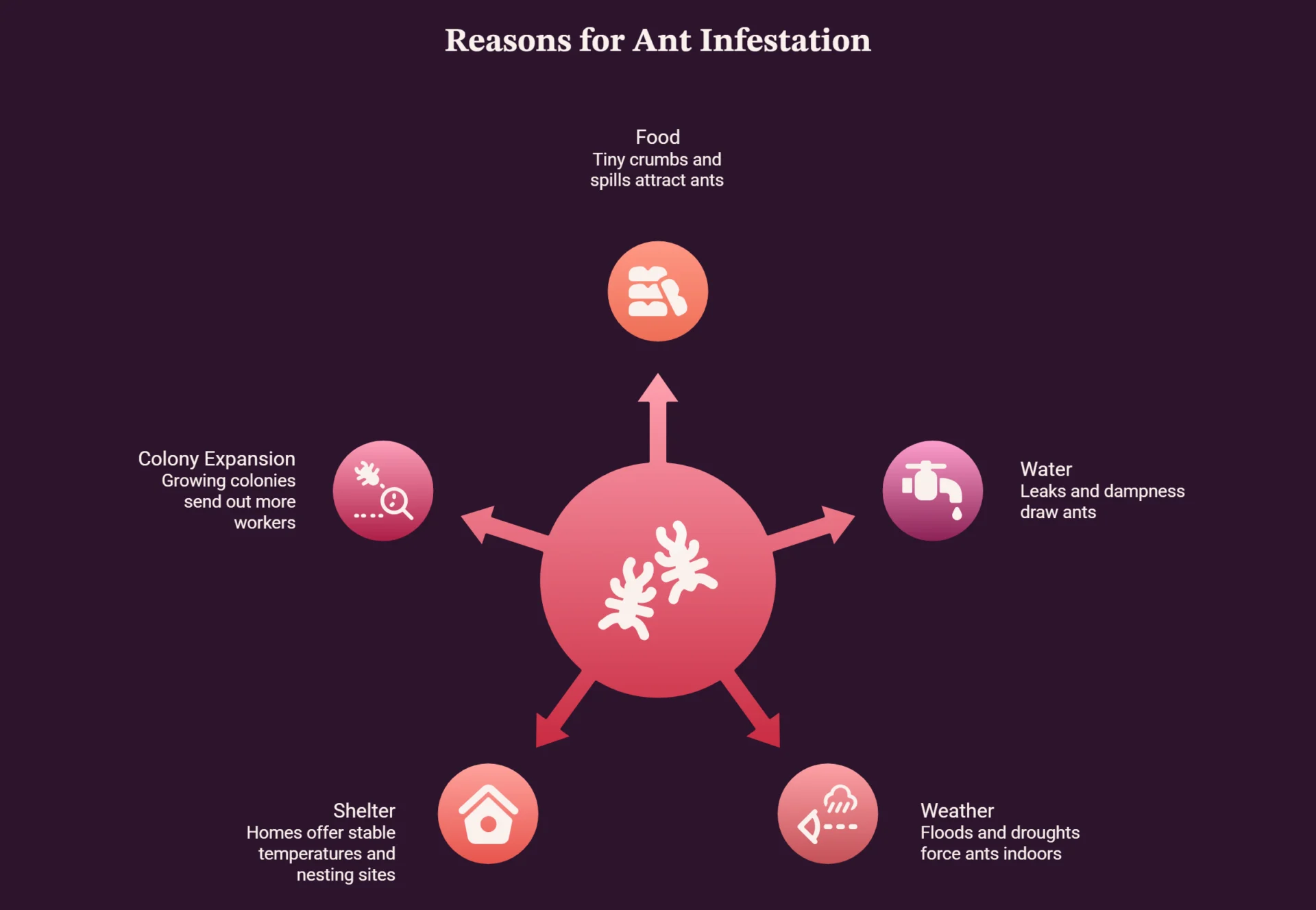
This is one of the most common questions we receive. The answer isn’t always as simple as “they’re looking for food.” Ants enter homes for several different reasons depending on the season, weather conditions, and species involved.
Food
Even tiny crumbs, sugary spills, grease residue, pet food, or uncovered pantry items can attract foraging workers. Many ants require only a very small food source to establish a regular trail.
Water
Moisture is often overlooked. Leaking pipes, damp crawl spaces, condensation, and even pet water bowls can attract certain species. Some ants actively seek moisture during dry weather.
Weather
Heavy rainfall may flood underground colonies, forcing workers to relocate temporarily. Extended drought can also encourage ants to search indoors for water. Rapid temperature changes frequently influence foraging behavior.
Shelter
Homes provide stable temperatures, protection from predators, and countless hidden nesting locations. Wall voids, insulation, crawl spaces, and expansion joints all create opportunities for certain species.
Seasonal Colony Expansion
As colonies grow throughout the spring and summer, food demands increase dramatically. That means more workers are sent out to explore larger areas, increasing the likelihood that some eventually find their way indoors.
Need fast, reliable help? Our team is ready to assist you today.
Does Seeing One Ant Mean You Have an Infestation?
Not necessarily.
One of the most important things homeowners can understand is that seeing an occasional ant is not always the same as having an established infestation. Worker ants routinely travel considerable distances while searching for food and water. An individual ant wandering across your kitchen counter may simply be exploring.
However, repeated sightings deserve more attention. You may have a larger problem if you notice:
- Consistent trails following the same route.
- Large numbers of ants appearing indoors.
- Activity in multiple rooms.
- Winged ants emerging indoors.
- Carpenter ants around damp or damaged wood.
- Recurring infestations despite cleaning.
Patterns matter more than isolated sightings. Understanding those patterns often helps determine whether you’re observing normal outdoor foraging or evidence of a nearby colony.
Why DIY Ant Sprays Often Don’t Solve the Problem
It’s understandable why many homeowners reach for an over-the-counter ant spray as soon as they notice ants inside their home. Seeing immediate results can be satisfying, but unfortunately, those results are often temporary.
Most store-bought ant sprays kill only the ants that are directly contacted during application. In most situations, those visible ants represent only a small fraction of the entire colony.
Remember the scout ant we discussed earlier? Once a food source has been located, dozens or even hundreds of worker ants may begin following the same pheromone trail back and forth between the colony and your home. Eliminating the workers you can see doesn’t necessarily affect the queen, developing brood, or the rest of the colony.
In some situations, spraying visible ants can actually make it more difficult to identify where they’re coming from by disrupting the very trails that help pinpoint their nesting location.
This doesn’t mean over-the-counter products never have a place. Small, isolated problems may sometimes be managed successfully by homeowners. However, when ants continue returning despite repeated treatments, it usually indicates that the colony itself has not been addressed.
Long-term ant management focuses on understanding the species involved, locating where the colony is nesting, and selecting treatment methods appropriate for that specific ant.
How to Help Prevent Ants Around Your Home
No home is completely immune to ants. Even well-maintained properties may occasionally experience foraging ants, particularly during periods of rapid colony growth or changing weather conditions.
Fortunately, a few simple maintenance practices can significantly reduce the likelihood of repeated invasions.
Eliminate Food Sources
Store pantry items in sealed containers whenever practical and promptly clean up food spills and crumbs. Pay particular attention to:
- Sugary drinks
- Syrups
- Pet food
- Grease around cooking areas
- Fallen fruit
- Trash and recycling containers
Even small amounts of food can attract foraging workers.
Reduce Moisture
Several ant species are attracted to damp environments. Inspect your home for:
- Leaking plumbing
- Condensation
- Roof leaks
- Damp crawl spaces
- Poor drainage
- Standing water near the foundation
Correcting moisture problems not only discourages ants but can also reduce conditions favorable for other pests.
Seal Exterior Entry Points
Although ants can enter through incredibly small openings, sealing obvious gaps around utility penetrations, doors, windows, and foundation cracks may reduce the number of foraging workers entering your home. Complete exclusion isn’t always possible, but reducing access points helps.
Maintain Landscaping
Trees, shrubs, and mulch placed directly against the home can create convenient travel routes for ants. Maintaining a small gap between vegetation and the structure, trimming branches away from the roofline, and limiting excessive mulch buildup against the foundation can reduce opportunities for ants to move indoors.
Monitor Early Activity
A few ants in early spring may not seem significant, but recurring activity often provides valuable clues about where colonies are developing. Addressing problems early is usually easier than waiting until colonies have expanded during the peak summer months.
How Zuckerman’s Approaches Ant Management
Every ant problem begins with a simple question: “What species are we dealing with?”
Because different ants behave differently, effective management starts with proper identification, not simply treating every infestation the same way.
During an inspection, we evaluate several factors, including:
- The species of ant present.
- Where the ants are nesting.
- How they’re entering the structure.
- Food and moisture sources that may be attracting them.
- Conditions around the property that support continued activity.
Rather than focusing only on the ants you can see today, our goal is to identify why they’re there in the first place and recommend solutions designed to provide longer-lasting results.
Depending on the species and situation, recommendations may include targeted treatments, exterior preventative services, habitat modification, exclusion recommendations, or ongoing preventative programs such as PestProtect 365.
Because every infestation is unique, treatment methods and warranty coverage vary based on the ant species, environmental conditions, and the specific service provided. For warranty information related to a particular ant or treatment program, please refer to your service agreement or the individual species pages within our Learning Library as they become available.
Conclusion
Ants are among the most successful and adaptable insects in the world, and encountering them around your home is a common part of living in Central Ohio. In many cases, a few wandering workers are simply doing what ants have evolved to do: searching for food, water, or new territory.
The key is understanding when occasional activity becomes a recurring problem.
By identifying the species, recognizing why ants are entering your home, and addressing the conditions that attract them, homeowners can make informed decisions about prevention and treatment.
At Zuckerman’s Pest Management, we believe successful ant management begins with education. Whether you’re dealing with nuisance ants in the kitchen, carpenter ants around moisture-damaged wood, or repeated invasions despite previous treatments, our goal is to provide science-based recommendations tailored to your specific situation, not one-size-fits-all solutions.
Sources & References
This article was developed using information from authoritative scientific and educational resources, including:
- Entomological Society of America (ESA)
- Ohio State University Extension
- Purdue University Extension Entomology
- University of Kentucky Entomology
- Penn State Extension
- University of California Statewide Integrated Pest Management Program (UC IPM)
- United States Department of Agriculture (USDA)
- National Pest Management Association (NPMA)
- Ohio Department of Natural Resources (ODNR), where applicable
About the Author
Jerika Zuckerman, ACE is the Co-Owner of Zuckerman’s Pest Management, a family-owned pest and wildlife management company serving homeowners and businesses throughout Central Ohio.
As an Associate Certified Entomologist (ACE) credentialed by the Entomological Society of America (ESA), Jerika combines years of practical field and office experience with a passion for insect biology, Integrated Pest Management (IPM), and consumer education. Through the Zuckerman’s Pest & Wildlife Learning Library, her goal is to help homeowners understand not just how to solve pest problems, but why they occur in the first place.
Need fast, reliable help? Our team is ready to assist you today.
Frequently Asked Questions
Why do ants suddenly appear in my home?
Ant activity often increases during the spring and summer as colonies expand and workers search for food and water. Changes in weather, including heavy rainfall or extended dry periods, can also encourage ants to move indoors.
Why do ants keep coming back after I spray them?
Most sprays eliminate only the ants you see. If the colony remains active, new workers often continue following established trails into your home.
Are all ants harmful?
No. Many ant species are beneficial insects that help recycle organic material, aerate soil, disperse seeds, and prey on other insects. Only a small number regularly become household pests.
Do carpenter ants eat wood?
No. Unlike termites, carpenter ants do not consume wood for food. Instead, they excavate galleries in damp or decaying wood to create nesting space for their colony.
What attracts ants into my kitchen?
Food residue, sugary spills, grease, pet food, moisture, and even small crumbs can all attract foraging workers.
Can ants damage my home?
Most household ants are simply nuisance pests. Carpenter ants are the primary species capable of contributing to structural damage because they tunnel through wood to create nesting galleries.
What are flying ants?
Flying ants are reproductive males and future queens produced by mature colonies during certain times of the year. Their appearance is a normal part of the colony’s life cycle, although they are often mistaken for termite swarmers.
When should I call a professional?
Professional evaluation is often recommended when:
Ants continue returning despite treatment.
You suspect carpenter ants.
Winged ants are emerging indoors.
Multiple areas of the home are affected.
Large numbers of ants are consistently present.