From the first warm days of spring through the cooler evenings of fall, Central Ohio comes alive with bees, wasps, and other stinging insects. Some quietly pollinate gardens and flowering trees, while others build nests beneath decks, inside wall voids, or high in backyard trees. Most are simply going about their role in nature—but when their nesting locations overlap with our homes, businesses, or outdoor living spaces, they can quickly become a concern.
One of the biggest misconceptions we encounter is that every flying insect with a stinger is a “bee.” In reality, Ohio is home to many different types of stinging insects, each with its own appearance, nesting habits, behavior, and importance to the environment. A honey bee colony inside a wall requires a very different solution than a yellowjacket nest hidden underground or a paper wasp colony tucked beneath a porch roof.
Understanding those differences is the foundation of effective pest management.
At Zuckerman’s Pest Management, we believe education should come before treatment. Rather than relying on fear or recommending the same solution for every situation, we focus on identifying the species, evaluating the location, understanding the level of risk, and recommending the most appropriate course of action. Sometimes that means professional treatment. Other times it means live removal, monitoring, or simply allowing beneficial insects to complete their natural life cycle.
This guide serves as the cornerstone of the Stinging Insects section within the Zuckerman’s Pest & Wildlife Learning Library. Whether you’ve discovered a nest on your home, noticed increased activity around your yard, or simply want to learn more about Ohio’s stinging insects, this guide will help you understand what you’re seeing and what to do next.
Need fast, reliable help? Our team is ready to assist you today.
Quick Facts About Stinging Insects in Ohio
| Topic | Information |
| Primary Activity Season | March through October |
| Peak Activity | July through September |
| Most Common Around Homes | Paper Wasps, Yellowjackets, Carpenter Bees, Honey Bees |
| Beneficial Species? | Yes. Many species are valuable pollinators or natural predators of other insects. |
| Should Every Nest Be Removed? | No. Many nests pose little or no risk when located away from people. |
| Most Common Nest Locations | Soffits, decks, trees, shrubs, wall voids, underground burrows, sheds, fences, attics |
| Professional Identification Recommended? | Yes. Different species require different management approaches. |
What Are Stinging Insects?
The term stinging insect generally refers to insects capable of injecting venom through a modified egg-laying structure known as a stinger. In Ohio, nearly all of the stinging insects homeowners encounter belong to the scientific order Hymenoptera, which includes bees, wasps, hornets, ants, and many other insects.
Although these insects are often grouped together, they are far from identical.
Some are highly social, living in colonies containing hundreds or even thousands of individuals. Others live completely solitary lives, with each female constructing her own nest and caring for her own offspring. Some spend their days collecting nectar and pollen, while others hunt caterpillars, spiders, flies, or cicadas to feed their developing young.
These differences matter because they directly influence:
- How likely an insect is to sting.
- Where it chooses to nest.
- Whether it provides important ecological benefits.
- The safest and most effective management options.
For homeowners, learning to recognize these differences can prevent unnecessary concern while helping identify situations that truly require professional attention.
Why Stinging Insects Are Important
Because most interactions with stinging insects happen when they become a nuisance, it’s easy to overlook the important role they play in Ohio’s environment.
In reality, many of these insects provide essential ecological services that benefit agriculture, wildlife, and even homeowners.
Pollinators
Honey bees, bumble bees, carpenter bees, and many native bee species transfer pollen between flowering plants as they forage for nectar. This process allows many trees, shrubs, vegetables, fruits, and wildflowers to reproduce.
Without pollinators, gardens would produce fewer vegetables, orchards would yield less fruit, and many native plant species would struggle to survive.
Natural Pest Control
Many wasps are excellent predators.
Rather than feeding exclusively on nectar, they hunt insects such as caterpillars, flies, aphids, and spiders to feed their developing larvae.
This natural predation helps keep many nuisance insect populations in check without the use of pesticides.
Supporting Ohio’s Ecosystem
Stinging insects also serve as food for birds, reptiles, amphibians, and mammals. They contribute to healthy ecosystems by supporting biodiversity and maintaining balanced food webs.
Simply put, not every stinging insect is a pest.
Many are beneficial neighbors that deserve appreciation rather than immediate removal.
Common Stinging Insects Found in Central Ohio
Ohio is home to hundreds of species of bees and wasps, but homeowners are most likely to encounter a relatively small group around homes and businesses.
Understanding the basic characteristics of these insects can help you better identify what you’re seeing and determine whether additional action is necessary.
Honey Bees
Honey bees are among the world’s most recognized insects—and for good reason.
These highly social pollinators live in organized colonies led by a single queen and may contain tens of thousands of worker bees during the height of summer.
Most honey bees spend their days collecting nectar and pollen from flowering plants, making them one of the most important pollinators in both agriculture and natural ecosystems.
Although they are capable of stinging, honey bees are generally focused on foraging rather than interacting with people. Most stings occur when bees believe their colony is being threatened or when they become trapped against skin or clothing.
One of the most common calls we receive each spring involves honey bee swarms. During this natural reproductive process, thousands of bees temporarily gather on a tree branch, fence, or shrub while scout bees search for a new permanent nesting location.
Although swarms can appear alarming, they are often one of the least defensive stages in a colony’s life cycle.
When honey bees establish colonies inside walls, chimneys, soffits, or other structural voids, professional intervention is usually recommended. Whenever practical and feasible, Zuckerman’s Pest Management favors live honey bee removal, helping preserve these important pollinators while protecting your property.
Bumble Bees
Bumble bees are among Ohio’s largest native pollinators and are easily recognized by their rounded bodies and dense covering of yellow and black hair.
Unlike honey bees, bumble bee colonies are relatively small, often containing only a few hundred individuals at their peak. Most colonies occupy abandoned rodent burrows, cavities beneath landscaping, compost piles, or other protected ground-level locations.
Bumble bees are exceptionally important pollinators and can even fly in cooler temperatures and lower light conditions than honey bees. They are responsible for pollinating many native plants as well as tomatoes, peppers, berries, and numerous flowering ornamentals.
Although female bumble bees can sting, they are generally calm insects that prefer to avoid confrontation. Colonies located away from regular human activity often complete their life cycle without causing any issues.
When a nest is located beneath a frequently used walkway, patio, or play area, however, evaluation by a pest management professional may be appropriate.
Carpenter Bees
Carpenter bees are one of the most commonly misidentified stinging insects in Central Ohio. At first glance, they look very similar to bumble bees because of their large size and black-and-yellow coloring. A closer look, however, reveals one of the easiest ways to tell them apart: carpenter bees have a smooth, shiny black abdomen, while bumble bees have a fuzzy abdomen covered in dense hair.
Unlike honey bees or paper wasps, carpenter bees don’t build colonies or paper nests. Instead, individual females excavate perfectly round entrance holes into unfinished or weathered wood. These tunnels, called nesting galleries, are used to raise the next generation of bees.
Common nesting locations include:
- Decks
- Wooden fences
- Pergolas
- Gazebos
- Fascia boards
- Wooden siding
- Outdoor furniture
- Playsets
- Barns and sheds
Many homeowners become concerned when they notice perfectly round holes in exposed wood or observe large bees hovering around their deck.
Fortunately, carpenter bees are generally not aggressive.
Male carpenter bees are well known for hovering near people and may appear intimidating as they defend nesting territories. Despite this behavior, male carpenter bees cannot sting. Female carpenter bees possess a stinger but are typically reluctant to use it unless directly handled or trapped.
While a single carpenter bee rarely causes significant structural damage, repeated nesting activity in the same wood year after year can weaken boards and create attractive habitat for woodpeckers searching for developing larvae.
Paper Wasps
Paper wasps are among the most familiar stinging insects found around homes throughout Central Ohio.
They build the open, umbrella-shaped paper nests commonly seen beneath porch ceilings, soffits, railings, window frames, shutters, mailboxes, and outdoor lighting fixtures.
Unlike honey bees, paper wasps create their nests by chewing weathered wood into a paper-like pulp, which they use to construct the distinctive gray combs that remain visible from below.
Paper wasp colonies typically begin each spring when a single overwintered queen starts building a new nest. As her first generation of workers matures, the colony expands throughout the summer before naturally declining in the fall.
Compared to yellowjackets, paper wasps are often less defensive when away from their nest. However, they will readily protect their colony if they believe it is being disturbed.
Because paper wasps frequently build nests near doors, patios, decks, and other areas where people regularly spend time, they are one of the most common stinging insects requiring professional removal.
Fortunately, early-season nests are often much smaller than those encountered later in the summer, making routine inspections an excellent way to identify developing colonies before they become larger.
Yellowjackets
If one stinging insect is responsible for the majority of unpleasant backyard encounters during late summer, it’s probably the yellowjacket.
Despite their appearance, yellowjackets are not bees. They are social wasps that live in colonies that may grow to several thousand workers by the end of the season.
Unlike paper wasps, which build exposed paper nests, many yellowjacket species in Ohio construct hidden nests underground, often taking over abandoned rodent burrows. Others may nest inside wall voids, crawl spaces, retaining walls, or structural cavities.
These concealed nesting locations make yellowjackets particularly challenging because homeowners may unknowingly mow over, walk near, or disturb an active colony.
One characteristic that surprises many homeowners is how dramatically yellowjacket behavior changes as summer progresses.
During spring and early summer, workers spend much of their time hunting insects to feed developing larvae. By late summer and early fall, as colony needs change, they become increasingly attracted to sugary foods and beverages.
This explains why yellowjackets seem to appear everywhere during backyard cookouts, sporting events, outdoor festivals, and family picnics.
Unlike honey bees, yellowjackets can sting repeatedly because their stinger does not become lodged in the skin.
When an underground colony is disturbed, multiple workers may respond simultaneously to defend the nest, making professional removal the safest option in many situations.
Bald-Faced Hornets
Despite their common name, bald-faced hornets are not true hornets.
They are actually one of the largest species of aerial yellowjackets found in Ohio.
Their striking black-and-white coloration and impressive football-shaped paper nests make them one of the easiest stinging insects to recognize.
Bald-faced hornets typically build their nests in:
- Trees
- Large shrubs
- Utility poles
- Building overhangs
- Occasionally beneath rooflines
Colonies expand steadily throughout the summer and may contain several hundred workers before the first hard frost.
These insects are beneficial predators, capturing flies, caterpillars, and many other insects to feed developing larvae.
However, they are also highly defensive of their nest.
Fortunately, bald-faced hornets rarely seek out people. Most stinging incidents occur only when someone unknowingly approaches or disturbs the colony.
Nests located high in trees often pose little concern and may simply be monitored until the colony naturally dies out during the fall.
Colonies located near entrances, sidewalks, playgrounds, or commercial properties often warrant professional evaluation.
European Hornets
European hornets are Ohio’s only true hornet species.
Because of their large size and loud flight, they are frequently mistaken for invasive “murder hornets,” despite being an entirely different species.
European hornets commonly nest inside hollow trees, barns, attics, wall voids, and other protected cavities.
Unlike many other wasps, they remain active after sunset and are often seen flying around porch lights and illuminated windows during warm summer evenings.
Although their size can make them appear intimidating, European hornets generally avoid confrontation while foraging.
Like many social wasps, they become defensive only when their colony is threatened.
Proper identification is important because their appearance is often confused with several other large wasp species found throughout Ohio.
Mud Daubers
Mud daubers are among the most misunderstood wasps in Ohio—and one of the least likely to cause problems.
Unlike social wasps, mud daubers live solitary lives.
Each female builds her own nest using mud collected from puddles, ponds, or moist soil. These distinctive tube-like nests are commonly found beneath eaves, inside garages, barns, sheds, crawl spaces, and other protected structures.
Instead of feeding on people or scavenging food, mud daubers hunt spiders, which they paralyze and place inside their nests as food for developing larvae.
Because they do not defend large colonies, mud daubers rarely sting and are generally considered one of the least aggressive stinging insects homeowners encounter.
Many homeowners choose to simply leave mud daubers alone unless the nests become unsightly or interfere with the use of a structure.
Cicada Killers
Few insects generate as many calls based solely on their appearance as cicada killers.
Measuring well over an inch in length, these impressive solitary wasps are among the largest stinging insects found in Ohio.
Despite their intimidating size, cicada killers are remarkably docile.
Females excavate burrows in sandy or well-drained soil, where they store paralyzed cicadas to feed developing larvae.
Males often patrol nesting areas and aggressively investigate passing people, creating the impression that they are preparing to attack.
In reality, male cicada killers cannot sting.
Females possess a stinger but rarely use it unless directly handled.
Because they are solitary insects rather than colony-forming wasps, cicada killers generally pose very little risk to homeowners.
How to Tell the Difference Between Bees, Wasps & Hornets
One of the most common questions we hear is:
“Is it a bee, a wasp, or a hornet?”
The answer matters because different species behave differently, provide different ecological benefits, and often require different management strategies.
Fortunately, there are several characteristics homeowners can use to make an educated identification.
| Feature | Bees | Wasps | Hornets |
| Body Appearance | Usually fuzzy or hairy | Smooth-bodied with a narrow waist | Large, smooth-bodied wasps |
| Primary Food Source | Nectar and pollen | Insects, nectar, sugary foods | Insects and sugary foods |
| Primary Benefit | Pollination | Natural pest control | Natural pest control |
| Typical Nest | Wax comb, underground, cavities or wood | Paper nests or underground colonies | Large enclosed paper nests or wall cavities |
| Temperament | Generally docile away from colony | Varies by species | Defensive near the nest |
| Can Sting More Than Once? | Honey bees typically no; many native bees can | Yes | Yes |
While this table provides a helpful starting point, it’s important to remember that many species look surprisingly similar. Correct identification often depends on several factors, including body shape, nesting location, behavior, and the time of year.
As our Learning Library grows, each species will have its own detailed guide with photographs, identification tips, and management recommendations.
When Are Stinging Insects Most Active in Ohio?
Understanding the seasonal life cycle of stinging insects can help explain why you may see very different activity levels throughout the year.
Early Spring (March–April)
As temperatures begin to warm, overwintering queens emerge from protected hiding places.
During this time, each queen begins searching for a suitable nesting location and starts building a new colony on her own.
Because colonies are still very small, this is often the easiest time to identify and address developing nests.
Late Spring (May–June)
The first generation of worker insects begins to emerge.
Colonies become more active, and homeowners often notice increased activity around decks, porches, sheds, landscaping, and flowering plants.
Honey bee swarms are also most commonly observed during this period as colonies naturally reproduce.
Summer (July–August)
This is the busiest time of year for nearly every stinging insect species.
Colonies continue expanding rapidly, and food demands increase significantly.
Homeowners spend more time outdoors during the summer, making encounters with stinging insects much more common.
Outdoor dining, gardening, mowing, and recreational activities often place people near active nests without realizing it.
Late Summer & Early Fall (August–October)
Many wasp species become noticeably more active around people.
As colonies mature, yellowjackets in particular shift from hunting insects to seeking sugary foods and drinks, leading to increased activity around patios, trash cans, sporting events, festivals, and backyard cookouts.
This is also the time of year when colonies are at their largest, making accidental nest disturbances more likely.
Late Fall & Winter
Most annual wasp and hornet colonies naturally die after the first hard frost.
Only newly fertilized queens survive the winter, finding sheltered locations where they remain dormant until spring.
Because old nests are generally not reused the following year, seeing an abandoned nest during the winter does not necessarily mean a new colony will return to that exact structure.
Where Are Stinging Insects Commonly Found?
Different species choose very different nesting locations.
Knowing where to look can help homeowners identify developing colonies before they become larger.
| Species | Common Nesting Locations |
| Honey Bees | Tree cavities, wall voids, chimneys, soffits, structural cavities |
| Bumble Bees | Underground burrows, landscape beds, compost piles |
| Carpenter Bees | Decks, fences, pergolas, fascia boards, exposed wood |
| Paper Wasps | Porch ceilings, soffits, shutters, railings, sheds |
| Yellowjackets | Underground burrows, retaining walls, wall voids |
| Bald-Faced Hornets | Trees, shrubs, building overhangs |
| European Hornets | Hollow trees, barns, attics, wall cavities |
| Mud Daubers | Garages, barns, crawl spaces, eaves |
| Cicada Killers | Sandy soil, lawns, landscape beds |
While these are the most common nesting locations, stinging insects are highly adaptable and may occasionally choose less typical sites depending on environmental conditions.
Are Stinging Insects Beneficial?
Absolutely.
One of the goals of this Learning Library is to help homeowners understand that not every stinging insect is a pest.
Many species provide valuable ecological services that directly benefit homeowners, agriculture, and Ohio’s native ecosystems.
Pollination
Honey bees, bumble bees, carpenter bees, and many native bee species pollinate countless flowering plants, fruits, vegetables, and ornamental landscapes.
Without pollinators, many gardens and agricultural crops would experience significantly reduced yields.
Natural Pest Control
Many wasps are highly effective predators.
Paper wasps, mud daubers, and other species help reduce populations of caterpillars, flies, spiders, and numerous garden pests naturally.
Supporting Biodiversity
Stinging insects also serve as an important food source for birds, reptiles, amphibians, and mammals, contributing to healthy ecosystems throughout Ohio.
Understanding these benefits helps homeowners make informed decisions about whether intervention is truly necessary.
When Do Stinging Insects Become a Problem?
While many stinging insects can safely coexist with people, there are situations where professional evaluation is appropriate.
Examples include:
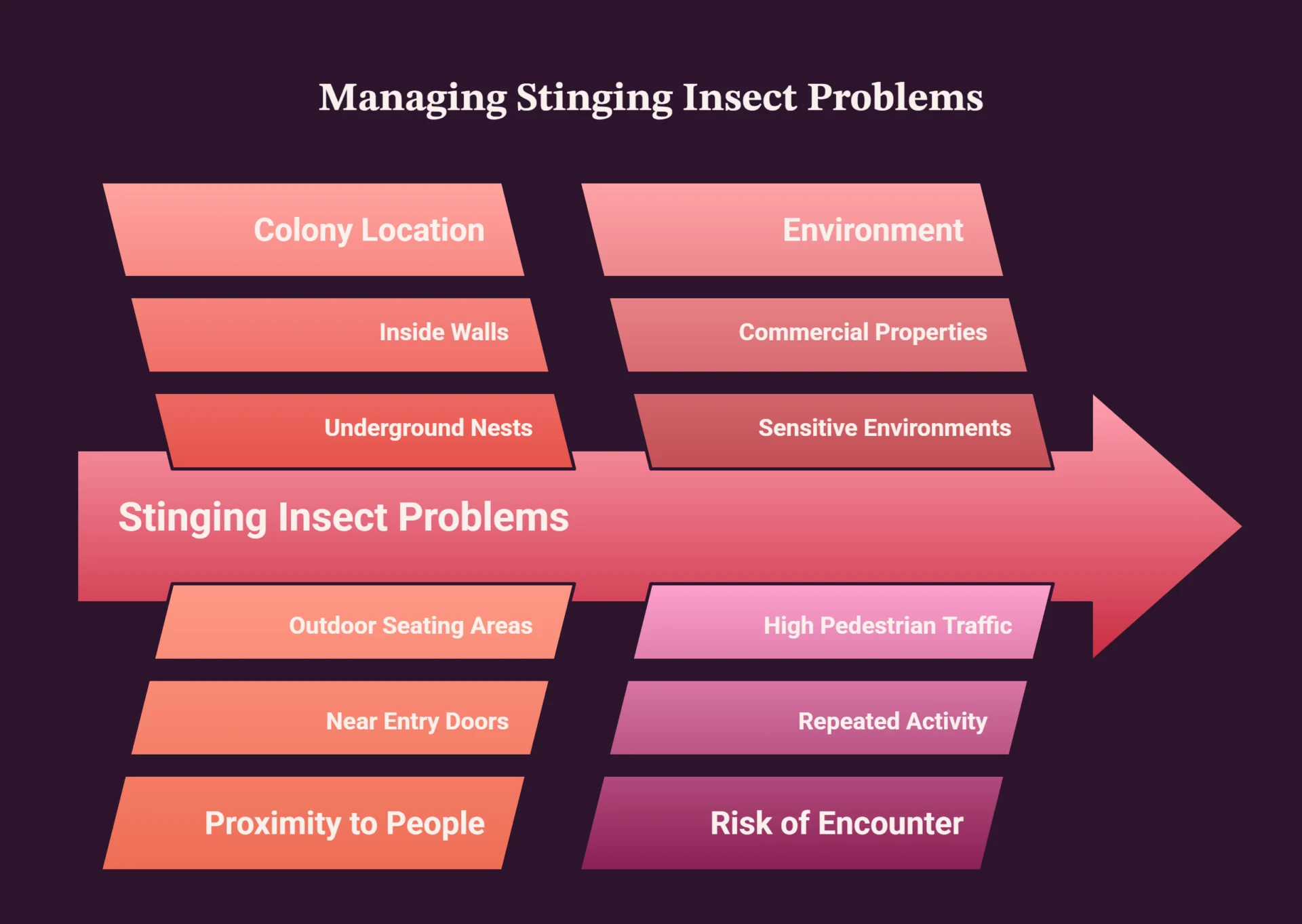
- Colonies located inside walls or structural voids.
- Underground nests in lawns or frequently used play areas.
- Nests adjacent to entry doors or walkways.
- Colonies near outdoor seating areas or patios.
- Commercial properties with heavy pedestrian traffic.
- Schools, daycare facilities, healthcare facilities, or other sensitive environments.
- Repeated activity creating a reasonable risk of accidental encounters.
The presence of stinging insects alone does not automatically mean treatment is necessary.
Need fast, reliable help? Our team is ready to assist you today.
Instead, we encourage homeowners to consider three important questions:
- What species is it?
- Where is it located?
- How likely are people or pets to encounter it?
Answering those questions often leads to a much better management decision than simply assuming every nest must be removed.
🐝 ACE Insight
With Jerika Zuckerman, Associate Certified Entomologist (ACE)
One of the most common mistakes I see is homeowners identifying insects based solely on color. Many bees, wasps, and hornets share similar black-and-yellow markings, yet their behavior, nesting habits, and ecological importance can be completely different. Proper identification isn’t just about knowing what insect you’re looking at—it’s the foundation for choosing the safest, most effective, and most environmentally responsible solution. Before deciding whether a nest should be removed, always start by identifying the species.
Should Every Stinging Insect Nest Be Removed?
One of the biggest misconceptions about stinging insects is that every nest represents an immediate danger.
In reality, the answer is much more nuanced.
Not every nest needs to be removed.
Many stinging insects are beneficial pollinators or natural predators that can safely coexist with people when their nests are located away from homes, walkways, patios, playgrounds, or other frequently used areas.
For example, a mud dauber nesting beneath the eaves of an unused shed presents a very different situation than an active yellowjacket colony hidden beneath a child’s swing set.
Likewise, a honey bee swarm resting on a tree branch may naturally relocate within a day or two, while a honey bee colony established inside a home’s wall cavity typically requires professional intervention.
The most appropriate course of action depends on several important factors, including:
- The species involved.
- The location of the nest.
- The size and maturity of the colony.
- The likelihood of people or pets encountering it.
- The purpose of the surrounding area.
This is why proper identification should always come before deciding whether treatment is necessary.
Why Species Identification Matters
Many homeowners understandably focus on one question:
“How do I get rid of it?”
At Zuckerman’s Pest Management, we encourage a different first question:
“What is it?”
Correct identification often changes the recommended solution entirely.
For example:
- A paper wasp nest beneath a porch roof may require a very different approach than a yellowjacket colony nesting underground.
- A honey bee colony inside a wall presents different challenges than a swarm temporarily resting in a tree.
- A carpenter bee damaging unfinished wood requires a different management strategy than a bumble bee colony pollinating your flower beds.
By identifying the insect first, we can recommend solutions that are safer, more effective, and appropriate for the specific species involved.
How Zuckerman’s Approaches Stinging Insect Management
No two stinging insect situations are exactly alike.
That’s why our recommendations begin with an inspection and proper identification rather than assuming every insect should be treated the same way.
When evaluating a stinging insect concern, we consider:
- The species involved.
- The nesting location.
- Whether the colony poses a realistic safety concern.
- The potential for continued activity.
- The property’s intended use.
- The most practical long-term solution.
Whenever practical and appropriate, our goal is to preserve beneficial insects while addressing situations that create unnecessary risk for homeowners, families, employees, customers, or guests.
Honey Bees
Because honey bees play such an important role as pollinators, live removal is our preferred approach whenever practical and feasible.
Depending on the situation, this may include:
- Swarm collection.
- Live colony removal.
- Structural cut-outs.
- Collaboration with local beekeepers when appropriate.
Each situation is unique, and recommendations are based on accessibility, colony location, structural considerations, and safety.
Wasps, Yellowjackets & Hornets
For nuisance wasps, yellowjackets, and hornets, treatment recommendations are based on:
- Species.
- Nest location.
- Colony size.
- Human activity nearby.
- Accessibility.
- Long-term prevention opportunities.
Rather than simply eliminating the visible insects, we focus on resolving the underlying issue while helping homeowners understand why the insects selected that location in the first place.
Service Warranties
Because every species behaves differently, warranty coverage varies depending on the insect involved, the service performed, environmental conditions, and the specific treatment program selected.
For warranty information related to a particular insect, please refer to that species’ individual Learning Library page or your service agreement.
Helping Reduce Stinging Insect Activity Around Your Property
While no property can be completely free of stinging insects, homeowners can often reduce unwanted activity by making their property less attractive for nesting.
Some simple preventative steps include:
Inspect Your Home Each Spring
Walk around your property every few weeks during the spring and early summer looking for newly developing nests beneath:
- Soffits
- Porch ceilings
- Deck railings
- Mailboxes
- Light fixtures
- Play equipment
- Sheds
- Gazebos
Small colonies are often much easier to address than mature colonies later in the season.
Seal Structural Openings
Repair damaged siding, soffits, vents, and trim that may allow insects access to wall voids or attic spaces.
Proper home maintenance helps reduce nesting opportunities for several species.
Keep Outdoor Eating Areas Clean
Especially during late summer, promptly cleaning outdoor dining areas and keeping garbage containers securely closed can reduce yellowjacket activity.
Maintain Your Landscape
Prune overgrown vegetation near structures, remove unnecessary debris, and monitor landscape features where underground nests commonly develop.
Respect Pollinators
If bees are simply visiting flowers in your landscape, there’s usually no reason for concern.
Foraging bees are focused on collecting nectar and pollen—not interacting with people.
Allowing pollinators to do their work benefits your landscape and Ohio’s environment.
Conclusion
Stinging insects have been part of Ohio’s landscape long before our homes and neighborhoods were built. Most are beneficial, many are fascinating, and only a small number become problems that require professional management.
Learning to identify the species, understanding its behavior, and recognizing when intervention is truly necessary are the first steps toward making informed decisions.
At Zuckerman’s Pest Management, we believe homeowners deserve honest, science-based information—not fear-based marketing. Whether you need help identifying a stinging insect, evaluating a nest, arranging a live honey bee removal, or addressing a colony that’s become a safety concern, our goal is always to recommend the most appropriate solution for your specific situation.
Sources & References
This article was developed using information from authoritative scientific and educational resources, including:
- Entomological Society of America (ESA)
- Ohio State University Extension
- Purdue University Extension Entomology
- University of Kentucky Entomology
- Penn State Extension
- University of California Statewide Integrated Pest Management Program (UC IPM)
- United States Department of Agriculture (USDA)
- Ohio Department of Natural Resources (ODNR)
- U.S. Environmental Protection Agency (EPA)
- Centers for Disease Control and Prevention (CDC), where medically appropriate
About the Author
Jerika Zuckerman, ACE is the Co-Owner of Zuckerman’s Pest Management, a family-owned pest and wildlife management company serving homeowners and businesses throughout Central Ohio.
As an Associate Certified Entomologist (ACE) credentialed by the Entomological Society of America (ESA), Jerika combines years of practical field and office experience with a continuing passion for the science of insects and Integrated Pest Management (IPM). Her work focuses on helping property owners understand the biology and behavior of pests so they can make informed, practical decisions about protecting their homes and businesses.
Through the Zuckerman’s Pest & Wildlife Learning Library, Jerika is committed to providing accurate, approachable, and science-based educational resources that empower readers with reliable information—not scare tactics.
Need fast, reliable help? Our team is ready to assist you today.
Frequently Asked Questions
Are all stinging insects aggressive?
No. Many species, including honey bees, bumble bees, mud daubers, and cicada killers, are generally calm unless directly threatened or their nest is disturbed.
Why are there suddenly so many wasps around my house?
Most colonies grow steadily throughout the summer, reaching their largest size in late summer and early fall. Increased activity during this time is a normal part of their life cycle.
Can I remove a nest myself?
Small, easily accessible nests may appear simple to remove, but disturbing the wrong species or an active colony can quickly become dangerous. Professional identification is often the safest first step.
Do wasps reuse the same nest every year?
Most paper wasps, yellowjackets, and bald-faced hornets build new nests each year. However, favorable nesting locations may attract new queens in future seasons.
Are honey bee swarms dangerous?
Honey bee swarms often appear intimidating because of the large number of bees involved, but they are typically one of the least defensive stages of a colony’s life cycle. Even so, they should never be disturbed and should be evaluated by a professional.
Can carpenter bees damage my home?
Individual carpenter bees rarely cause significant structural damage, but repeated nesting activity over several years can weaken exposed wood and attract woodpeckers searching for larvae.