Why Bugs Suddenly Appear in Your Homeand What You Can Do About It
Every year, usually around the first cool days of late summer and fall, our office starts receiving a flood of phone calls from homeowners across Central Ohio.
“Hundreds of bugs suddenly appeared in my house.”
“Why are they all over my windows?“
“They seem to be coming from nowhere!“
“I’ve lived here for yearswhy is this happening now?“
If you’ve ever experienced a sudden invasion of insects seemingly overnight, you’re certainly not alone.
The good news is that, in many cases, these insects aren’t trying to establish a permanent infestation inside your home. Many belong to a group that pest management professionals commonly refer to as occasional invadersinsects that normally live outdoors but enter homes while searching for shelter from changing weather conditions.
Understanding why these insects appear, when they’re most active, and how they gain access to your home is often the first step toward reducing future invasions.
In this guide, you’ll learn about the most common occasional invaders found throughout Central Ohio, why they suddenly seem to appear in large numbers, practical prevention strategies, and when professional pest management may help reduce recurring seasonal activity.
Need fast, reliable help? Our team is ready to assist you today.
What Are Occasional Invaders?
Unlike insects that establish nests or colonies inside homes, occasional invaders typically spend mostor allof their lives outdoors.
As temperatures begin to cool, daylight hours shorten, or weather conditions become less favorable, these insects begin searching for protected places where they can survive until conditions improve. Unfortunately, homes, garages, sheds, attics, and commercial buildings often provide exactly the kind of shelter they’re looking for.
One important thing to understand is that your home usually isn’t attracting them because there’s a problem.
Instead, your home simply offers something they naturally seek:
- Protection from the weather
- Stable temperatures
- Dry shelter
- Small cracks and openings that provide easy access
In many neighborhoods, dozensor even hundredsof homes experience the exact same seasonal invasion at the same time. The insects aren’t choosing your house because it’s dirty or poorly maintained; they’re responding to seasonal changes that affect their entire population.
Why Do They Suddenly Show Up All at Once?
This is probably the question we’re asked most often.
The answer is surprisingly simple.
Most occasional invaders spend the spring and summer outdoors feeding, reproducing, and living completely unnoticed. As the seasons begin to change, thousands of insects across an entire neighborhood receive the same environmental signalscooler nights, shorter days, and changing temperaturesthat it’s time to begin searching for winter shelter.
That’s why it often feels like they appeared overnight.
In reality, they’ve been outside all year.
You’re only noticing them now because they’re gathering on sunny exterior walls, around windows, under siding, or finding small openings that allow them to move indoors.
Some homeowners assume a sudden invasion means something is wrong with their house.
More often than not, it’s simply a sign that nature is following its normal seasonal cycle.
🐝 ACE Insight
With Jerika Zuckerman, ACE
Associate Certified Entomologist • Co-Owner
One of the biggest misconceptions I hear is, “Why are all these bugs choosing my house?”
The truth is, they probably aren’t.
Many occasional invaders are responding to sunlight, temperature, wind, and seasonal changesnot selecting one particular home over another. In fact, it’s very common for an entire neighborhood to experience the same issue around the same time.
The good news is that understanding why they’re there helps us choose the most effective ways to reduce future activity. Identifying the species, understanding its seasonal behavior, and looking at how it’s getting inside often tells us far more than simply counting how many insects you’ve found.
Common Occasional Invaders Found in Central Ohio
Although dozens of insect species occasionally find their way indoors, a handful account for the vast majority of seasonal calls we receive throughout Central Ohio.
Each behaves a little differently, but they all share one thing in commonthey’re looking for a safe place to ride out unfavorable conditions.
In the sections below, we’ll introduce some of the most common occasional invaders and link to detailed identification guides for each species so you can learn more about the insects you’re seeing.
Common Occasional Invaders Found in Central Ohio
While dozens of insects may occasionally find their way indoors, a relatively small group accounts for the majority of seasonal calls we receive from homeowners throughout Central Ohio. Learning to recognize these insects can help you better understand why they’re there and what steps, if any, should be taken.
Brown Marmorated Stink Bugs
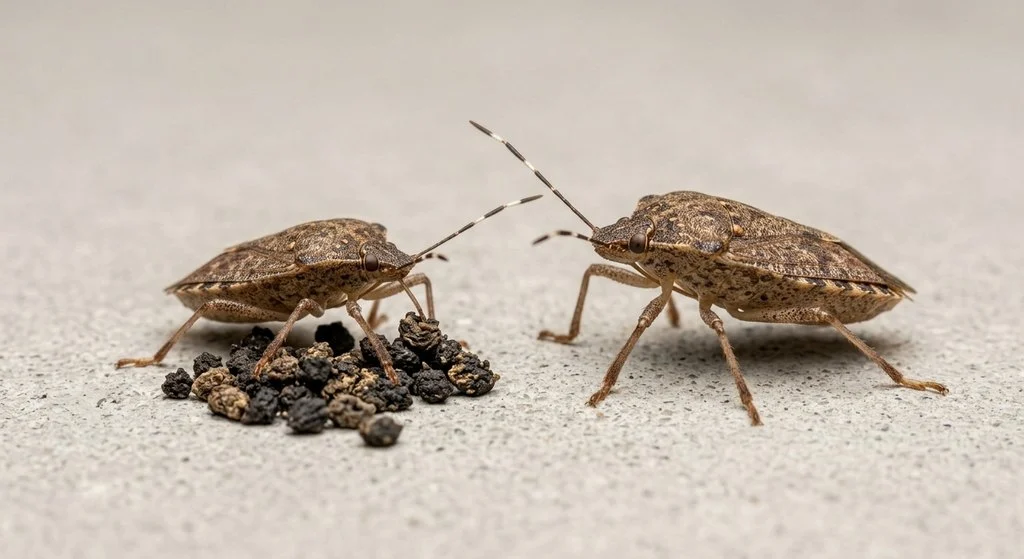
Brown marmorated stink bugs have become one of Ohio’s most recognizable fall invaders. As temperatures begin to cool, they gather on sunny exterior walls before slipping through small gaps around windows, siding, soffits, and rooflines in search of sheltered overwintering sites.
Although they can become a nuisance indoors, stink bugs do not reproduce inside homes, damage structures, or pose a significant health risk to people or pets.
Asian Lady Beetles
Often mistaken for native ladybugs, Asian lady beetles are beneficial predators outdoors where they feed on aphids and other plant pests. Unfortunately, they also have a habit of gathering in large numbers on homes during the fall as they search for protected places to spend the winter.
Inside, they may become a nuisance by clustering around windows, ceilings, and light-colored walls. While they rarely infest homes, they can stain surfaces and release an unpleasant odor if crushed.
Boxelder Bugs
Boxelder bugs are frequently found around boxelder, maple, and ash trees. Like many occasional invaders, they become more noticeable during the fall when they gather on warm, sunny sides of buildings before seeking shelter indoors.
Although they don’t damage homes or reproduce indoors, large numbers can quickly become frustrating for homeowners.
Cluster Flies
Unlike house flies, cluster flies develop outdoors as parasites of earthworms before entering buildings to overwinter. Homeowners often notice them on warm winter days or sunny spring afternoons as they emerge from wall voids and attic spaces.
Finding cluster flies indoors doesn’t necessarily mean something has died inside your wallsit’s simply part of their normal seasonal behavior.
Springtails
Springtails are tiny moisture-loving insects commonly found around mulch, landscaping, foundation walls, and damp areas. Heavy rainfall, excessive moisture, or high humidity can drive large numbers indoors, particularly around basements, bathrooms, and first-floor windows.
Although their numbers may seem alarming, springtails do not bite, sting, damage structures, or reproduce extensively indoors without favorable moisture conditions.
Clover Mites
Clover mites are extremely small reddish-brown mites that often appear crawling across windows, siding, patios, and interior windowsills during the spring and fall.
They don’t bite people or pets, but they can leave reddish stains if crushed, making them an unwelcome visitor inside many homes.
Silverfish & Firebrats
Silverfish and their close relatives, firebrats, thrive in dark, humid environments where they feed on paper products, starches, adhesives, fabrics, and other organic materials.
Although they’re not considered dangerous, their presence may indicate excess moisture that should be investigated.
Earwigs
Despite decades of myths and folklore, earwigs do not crawl into people’s ears.
These nocturnal insects prefer cool, damp hiding places outdoors but occasionally wander inside while searching for moisture or shelter. They’re commonly found beneath mulch, stones, flower pots, and landscaping before accidentally entering homes.
House Centipedes
House centipedes are one of the few occasional invaders that many homeowners find more frightening than harmful. Their long legs and rapid movement can certainly be startling, but they’re actually beneficial predators that feed on other insects.
Seeing a house centipede often suggests there’s another insect population providing a food source nearby.
Millipedes
Millipedes spend most of their lives outdoors, feeding on decaying organic matter in mulch, leaf litter, and damp soil. During periods of heavy rain or changing weather, they may migrate in large numbers and accidentally enter homes.
Once indoors, they typically don’t survive long because the environment lacks the moisture they need.
Camel Crickets
Also known as cave crickets or spider crickets, camel crickets prefer cool, damp environments such as crawl spaces, unfinished basements, garages, and utility rooms.
Although their appearance can be intimidating, they’re generally harmless and don’t damage structures.
Sowbugs & Pillbugs
Often called “roly-polies,” sowbugs and pillbugs are actually crustaceans rather than insects. They require consistently moist environments to survive and are commonly found beneath mulch, rocks, landscaping timbers, and leaf litter.
Finding them indoors often points to excessive moisture around the foundation or nearby landscaping.
Why Do Some Homes Experience More Occasional Invaders Than Others?
One question we hear frequently is:
“Why does my house seem to get all the bugs while my neighbor barely has any?“
The answer usually comes down to a combination of location, construction, landscaping, and environmental conditions rather than simple luck.
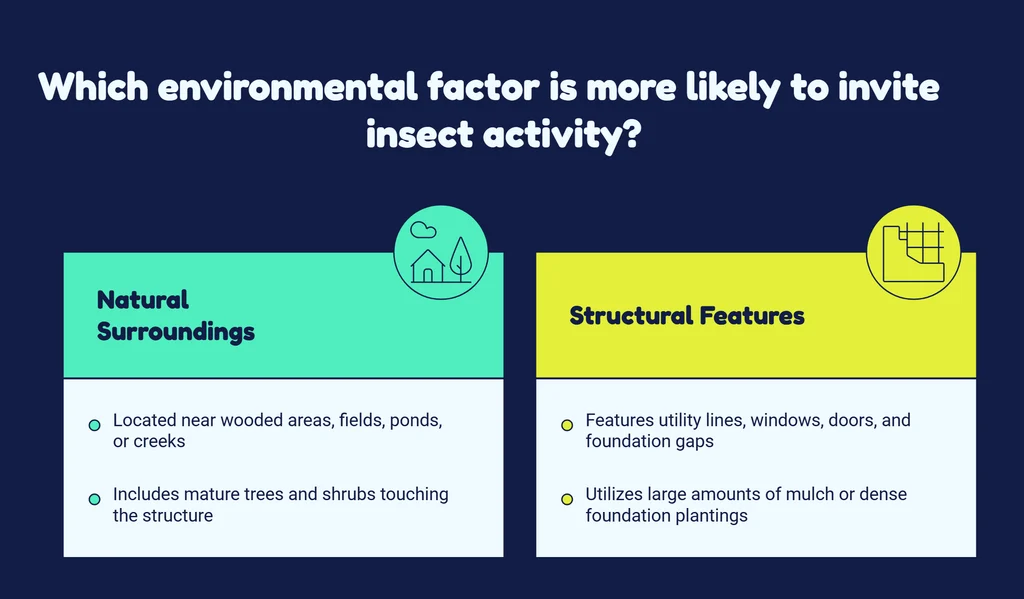
Homes located near wooded areas, fields, ponds, creeks, or large landscaped lots often experience greater seasonal insect activity because they’re naturally closer to where many insects live outdoors.
Construction also plays a role. Every home has small gaps and openings around utility lines, windows, doors, rooflines, siding, vents, and foundations. While many of these openings are harmless from a construction standpoint, they can become convenient entry points for insects searching for shelter.
Other factors that may increase occasional invader activity include:
- Homes with light-colored siding that absorbs afternoon sun
- Large amounts of mulch or dense landscaping against the foundation
- Exterior lighting that attracts insects at night
- Moisture around the foundation
- Mature trees and shrubs touching the structure
- Unsealed utility penetrations
- Aging weather stripping and door sweeps
The presence of occasional invaders doesn’t necessarily mean your home has a serious problem. More often, it simply means your home offers shelter during seasonal weather changesand insects are remarkably good at finding even the smallest opportunities.
Need fast, reliable help? Our team is ready to assist you today.
🐝 ACE Insight
With Jerika Zuckerman, ACE
Associate Certified Entomologist • Co-Owner
People sometimes assume they did something wrong because insects suddenly appeared inside their home.
Most of the time, that’s simply not the case.
Many occasional invaders are responding to predictable seasonal cues that affect thousands of insects across an entire area. While every home is different, these seasonal movements are a normal part of many insects’ life cycles. Understanding their behavior allows us to focus on practical prevention rather than chasing individual insects around the house.
Can Occasional Invaders Be Prevented?
While no home can be completely sealed against every insect, there are many practical steps homeowners can take to reduce seasonal invasions.
Some of the most effective strategies include:
- Repair damaged window and door screens.
- Replace worn weather stripping and door sweeps.
- Seal gaps around utility lines and exterior penetrations.
- Repair cracks in foundations and siding where appropriate.
- Keep shrubs, tree branches, and dense vegetation trimmed away from the structure.
- Reduce excessive moisture around the foundation.
- Consider replacing bright white exterior bulbs with warmer-colored lighting where appropriate.
- Store firewood away from the home whenever possible.
- Remove heavy accumulations of leaves and organic debris against the foundation.
- Schedule routine preventative pest management before seasonal activity begins.
These simple improvements won’t eliminate every occasional invader, but together they can significantly reduce the number of insects finding their way indoors.
When Is Professional Treatment Recommended?
Many occasional invaders can simply be removed with a vacuum or addressed as individual insects appear. However, when large seasonal invasions become a recurring problem, professional pest management can often make a noticeable difference.
Professional treatment may be appropriate when:
- Large numbers of insects return year after year.
- Activity begins affecting multiple areas of the home.
- Exterior congregations become excessive.
- Insects continue appearing despite routine maintenance.
- You’re unsure which species you’re dealing with.
- You’d like to reduce activity before seasonal invasions begin.
One of the advantages of preventative pest management is that treatments are often timed around insect behavior rather than simply reacting after insects have already entered the home.
At Zuckerman’s Pest Management, our goal isn’t to promise that you’ll never see another insect. Instead, we focus on reducing seasonal pest pressure, helping prevent recurring invasions, and providing practical recommendations tailored to your home and property.
Related Services
If seasonal insects continue returning year after year, professional pest management can help reduce pest pressure before activity becomes overwhelming.
Depending on the insects involved and your property’s unique conditions, we may recommend one-time treatment, preventative exterior applications, or a year-round pest management program designed to provide ongoing protection.
Learn About Our Services
Pest Protect 365 Home
Our most popular residential program provides year-round preventative pest management designed to reduce activity from many of the occasional invaders discussed in this guide while also protecting against many of Central Ohio’s most common household pests.
One Time Pest Treatments
Ideal for homeowners experiencing a specific seasonal issue that doesn’t require ongoing service.
Annual Comprehensive Pest Inspection
A detailed inspection helps identify conducive conditions, likely entry points, moisture concerns, and other factors that may be contributing to recurring pest activity.
Still Not Sure What You’re Seeing?
Not every insect fits neatly into one categoryand many homeowners aren’t expected to know the difference between a boxelder bug, a stink bug, a beetle, or a springtail.
That’s where we can help.
Whether you’re trying to identify an insect, understand why it’s appearing, or determine whether professional treatment is appropriate, our team is happy to provide guidance and recommend the best next steps for your situation.
Need Help?
Schedule an Inspection →
Contact Zuckerman’s Pest Management →
Have a photo? Send it to we’re happy to help identify many common insects found throughout Central Ohio.
Meet the Expert Behind This Guide
Jerika Zuckerman, ACE
Associate Certified Entomologist • Co-Owner
Jerika Zuckerman is an Associate Certified Entomologist (ACE) through the Entomological Society of America and co-owner of Zuckerman’s Pest Management. She specializes in insect identification, integrated pest management (IPM), preventative pest control strategies, and educating homeowners and businesses about the pests commonly found throughout Central Ohio.
Through the Zuckerman’s Pest & Wildlife Learning Library, Jerika combines scientific research, continuing education, and real-world field experience to help readers better understand pest behavior and make informed decisions about protecting their homes and businesses.
Sources & References
The information presented in this guide is based on current scientific literature, university extension resources, professional pest management practices, and field experience serving homes and businesses throughout Central Ohio.
Primary references include:
- Entomological Society of America (ESA)
- Ohio State University Extension
- National Pest Management Association (NPMA)
- Ohio Department of Agriculture (ODA)
- University extension publications
- Peer-reviewed entomological research
- Manufacturer technical bulletins where applicable
Educational Disclaimer
This guide is intended for educational purposes and discusses the occasional invaders most commonly encountered throughout Central Ohio. Pest activity varies depending on geography, weather conditions, surrounding habitat, construction, and individual property characteristics. While this guide provides general recommendations, every situation is unique and may benefit from a professional inspection.
Need fast, reliable help? Our team is ready to assist you today.
Frequently Asked Questions
Why do bugs suddenly appear in my house every fall?
Many occasional invaders spend the spring and summer outdoors before searching for sheltered places to overwinter as temperatures begin to cool. Homes often provide the stable, protected environment they’re naturally seeking.
Are occasional invaders dangerous?
Most occasional invaders found in Central Ohio are considered nuisance pests rather than dangerous pests. While they can certainly become frustrating, many do not bite, sting, reproduce indoors, or damage structures.
Will occasional invaders reproduce inside my home?
Most species discussed in this guide do not establish breeding populations indoors. They typically enter seeking temporary shelter and eventually become inactive or attempt to leave when weather conditions improve.
Why do they always gather around my windows?
Windows often receive warmth from sunlight and contain small gaps around frames or trim that insects can use while searching for sheltered overwintering sites. They’re also attracted to light, making windows a common place to notice activity.
What’s the best way to keep occasional invaders out?
The best long-term approach combines good home maintenance, sealing potential entry points where practical, reducing conditions that attract insects, and maintaining a preventative pest management program that addresses seasonal activity before it becomes a problem.
Should I be worried if I find just one?
Not necessarily. Finding an occasional invader indoors doesn’t automatically indicate an infestation. However, seeing increasing numbersespecially during seasonal transitionsmay suggest that insects are finding multiple ways to enter the structure and could warrant a closer inspection.