Bees, Wasps, Hornets & Yellowjackets,How to Identify Them and Know When Action Is Needed
Seeing flying insects around your home can raise a lot of questions.
Are they bees or wasps?
Is the nest dangerous?
Should I leave them alone or have them removed?
Can I spray it myself?
The truth is, not every stinging insect should be treated the same way.
Some species are valuable pollinators that play an important role in our environment. Others can become aggressive when defending their nests and may pose a safety concern for families, pets, employees, or customers.
The key is understanding which insect you’re dealing with before deciding how to respond.
At Zuckerman’s Pest Management, we believe that proper identification should always come before treatment. Whenever possible, we focus on protecting beneficial pollinators while recommending practical, effective solutions for species that create safety concerns or establish nests on or inside structures.
In this guide, we’ll introduce the most common stinging insects found throughout Central Ohio, explain how they differ, discuss when professional treatment may be appropriate, and help you understand the options available for protecting both your property and the important insects that share our environment.
Not Every Stinging Insect Is a Pest
One of the biggest misconceptions we encounter is that every bee or wasp flying around a home needs to be eliminated.
In reality, many stinging insects are beneficial.
Honey bees pollinate crops and flowering plants.
Bumble bees are among Ohio’s most important native pollinators.
Many solitary wasps help control garden pests by feeding on insects that damage landscapes and ornamental plants.
Others, however, can become problematic when they build nests in wall voids, attics, soffits, decks, playground equipment, or other locations where people and insects are likely to come into close contact.
Rather than treating every flying insect the same way, we first identify the species, evaluate the location of the nest, assess the potential risk, and recommend the most appropriate solution.
Sometimes that solution is treatment.
Sometimes it’s exclusion.
Sometimes it’s professional honey bee removal.
And sometimes the best recommendation is simply to leave the insects alone.
Need fast, reliable help? Our team is ready to assist you today.
ACE Insight
With Jerika Zuckerman, ACE
Associate Certified Entomologist • Co-Owner
One of the most common calls we receive starts with:
“I have bees.”
After a few questions,or sometimes just a photo,we often discover they aren’t bees at all.
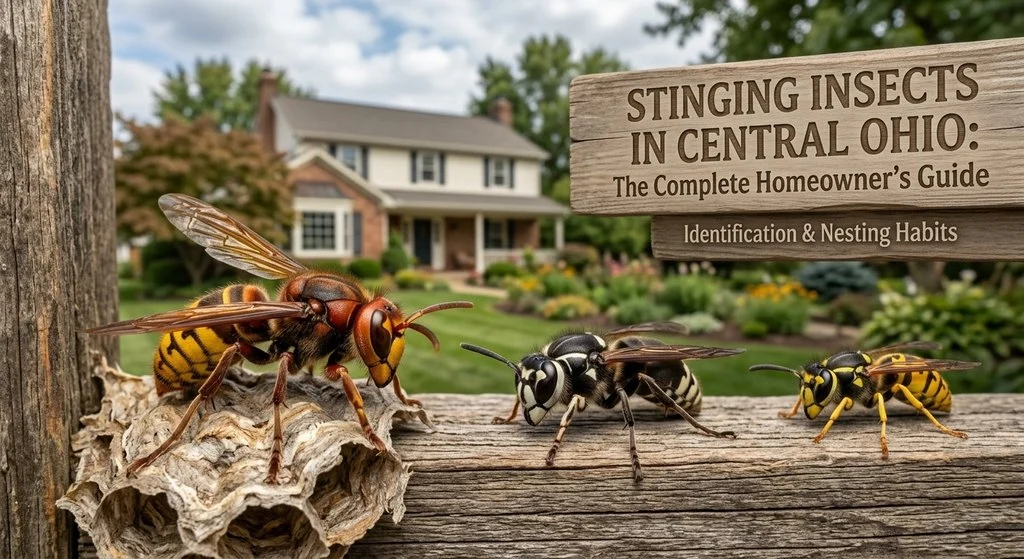
Yellowjackets, paper wasps, hornets, carpenter bees, honey bees, and several other insects are commonly mistaken for one another.
Correct identification doesn’t just satisfy curiosity. It determines whether treatment is appropriate, whether removal is possible, and what the safest long-term solution will be.
The Most Common Stinging Insects in Central Ohio
Although there are dozens of stinging insect species throughout Ohio, a relatively small number account for the vast majority of homeowner calls.
Let’s take a closer look at the species you’re most likely to encounter.
Honey Bees
Essential Pollinators
Honey bees are among the most beneficial insects in the world. They pollinate countless crops, gardens, trees, and flowering plants while playing a critical role in our food supply.
Unlike wasps, honey bees generally sting only when defending themselves or their colony. Because they lose their stinger after stinging, they typically die afterward.
When honey bees establish colonies inside walls, chimneys, soffits, or other parts of a structure, simply spraying the entrance is rarely the best solution. In many situations, professional removal of the colony is the preferred approach.
Whenever practical, we work with experienced beekeeping partners to evaluate options for responsible honey bee removal and relocation.
Yellowjackets
Small Insect, Big Attitude
Yellowjackets are among the most aggressive stinging insects commonly encountered in Central Ohio.
Unlike honey bees, they can sting multiple times and aggressively defend their nests when disturbed.
Many nests are built:
- Underground
- Inside landscape voids
- Wall cavities
- Retaining walls
- Utility boxes
They’re also attracted to sugary foods and proteins, making them common visitors at outdoor gatherings during late summer and early fall.
Paper Wasps
The Porch Builders
Paper wasps are responsible for many of the small umbrella-shaped nests found beneath:
- Porch ceilings
- Decks
- Eaves
- Railings
- Window frames
- Play equipment
Although generally less aggressive than yellowjackets, they will defend their nests if threatened.
Because these nests are often located directly beside entry doors or outdoor living areas, treatment is sometimes recommended to reduce the risk of accidental encounters.
Bald-Faced Hornets
Large Aerial Nest Builders
Despite their common name, bald-faced hornets are actually a type of yellowjacket.
They’re well known for constructing the large gray, football-shaped paper nests commonly seen hanging from trees, shrubs, utility poles, and occasionally buildings.
These colonies can become highly defensive when approached too closely.
Because of their size and aggressive behavior, professional removal is strongly recommended.
Learn More: Bald-Faced Hornets in Ohio →
European Hornets
Ohio’s Largest Social Wasp
European hornets are one of the largest social wasps found in Ohio.
They commonly nest inside:
- Hollow trees
- Wall voids
- Attics
- Barns
- Outbuildings
Unlike many other wasps, they’re often active after dark and may be attracted to lights around homes.
Although intimidating because of their size, they’re generally less aggressive than many people expect unless their nest is disturbed.
Bumble Bees
Gentle Native Pollinators
Bumble bees are among Ohio’s most important native pollinators and are essential to gardens, orchards, farms, and many flowering plants throughout Central Ohio.
Unlike honey bees, bumble bees typically live in much smaller colonies and often build nests in abandoned rodent burrows, landscape voids, compost piles, or other sheltered outdoor locations.
Although they can sting when their nest is threatened, they’re generally calm insects that spend their time gathering nectar and pollen rather than interacting with people.
In many situations, the best option is simply giving bumble bees the space they need to complete their relatively short seasonal colony.
Carpenter Bees
The Wood Drillers
Carpenter bees are frequently mistaken for bumble bees because of their similar size and appearance.
The easiest way to tell them apart is by looking at the abdomen.
- Bumble bees have a fuzzy, hairy abdomen.
- Carpenter bees have a smooth, shiny black abdomen.
Unlike social bees, carpenter bees don’t build large colonies. Instead, individual females drill perfectly round entrance holes into unfinished or weathered wood where they create tunnels to raise their young.
Over time, repeated tunneling can damage decks, fences, pergolas, sheds, fascia boards, and other wooden structures.
Although male carpenter bees often hover aggressively near people, they cannot sting. Females are capable of stinging but rarely do unless they’re handled or trapped.
Because carpenter bees can cause structural damage over time, management often focuses on repairing existing galleries, preventing future nesting, and protecting exposed wood.
Cicada Killers
The Gentle Giants
Few insects generate more unnecessary panic than cicada killers.
These large solitary wasps can reach nearly two inches in length, making them one of the largest wasps found in Ohio.
Fortunately, they’re also among the least aggressive.
Female cicada killers spend their time hunting cicadas, which they carry back to underground burrows to feed developing offspring.
Male cicada killers often hover near people to defend territory, but they don’t have stingers.
Although their size can be intimidating, they’re generally considered beneficial insects and rarely require treatment unless their nesting activity creates repeated problems in high-traffic areas.
Mud Daubers
Nature’s Spider Hunters
Mud daubers are solitary wasps that build distinctive tube-shaped nests from mud beneath eaves, garages, barns, sheds, and other protected areas.
Unlike yellowjackets and hornets, mud daubers don’t defend their nests aggressively and rarely sting people.
They’re actually beneficial predators that capture spiders,including black widows in some parts of the country,to provision their nests.
In most situations, mud daubers are simply a nuisance because of the mud nests they leave behind rather than because they present any safety concern.
Should Every Nest Be Removed?
No.
One of the biggest differences between our approach and the “spray first, ask questions later” mentality is that we evaluate both the insect and the location of the nest before recommending treatment.
A paper wasp nest high in a tree may never create a problem.
A yellowjacket nest beside your front steps is a very different situation.
A honey bee colony inside the wall of your home deserves a different solution than a mud dauber nest on a backyard shed.
Every situation is unique.
Our goal is to recommend the solution that’s safest for your family while respecting the important role many stinging insects play in our environment.
ACE Insight
With Jerika Zuckerman, ACE
Associate Certified Entomologist • Co-Owner
One of my favorite parts of this job is helping homeowners realize that not every flying insect is “the bad guy.”
Many of the insects people call us about are actually providing tremendous ecological benefits by pollinating plants or helping control other insect populations.
When treatment is necessary, we’ll absolutely recommend it.
But when a nest can safely remain where it is,or when another solution makes more sense,we’ll tell you that too.
Our goal is to solve problems, not eliminate beneficial insects unnecessarily.
When Should You Call a Professional?
While some small, easily accessible nests may be safely removed under the right circumstances, many stinging insect situations are better left to trained professionals.
Professional assistance is recommended when:
- A nest is located inside a wall, attic, soffit, chimney, or other structure.
- The insects are entering and exiting your home.
- The nest is large or difficult to reach.
- The insects are behaving aggressively.
- Someone in the household has a known allergy to stings.
- The nest is located near doors, patios, decks, pools, playgrounds, or frequently used walkways.
- You aren’t sure what species you’re dealing with.
Attempting to remove or disturb a nest without proper identification and equipment can increase the risk of multiple stings and may make the situation worse.
How We Handle Stinging Insect Problems
Every service begins with one question:
What insect are we dealing with?
From there, we determine the safest and most appropriate solution.
Depending on the species and location, recommendations may include:
- Professional nest treatment
- Honey bee removal through our beekeeping partner
- Nest removal after treatment when appropriate
- Exclusion recommendations to prevent future nesting
- Monitoring when immediate treatment isn’t necessary
- Simply leaving beneficial insects alone when they don’t pose a safety concern
Not every nest needs to be destroyed.
Not every bee needs to be relocated.
And not every wasp needs to be feared.
Our job is to help you make the right decision based on your unique situation,not a one-size-fits-all approach.
Related Services
Every stinging insect situation is different. That’s why identifying the species is always our first priority.
Professional Stinging Insect Services
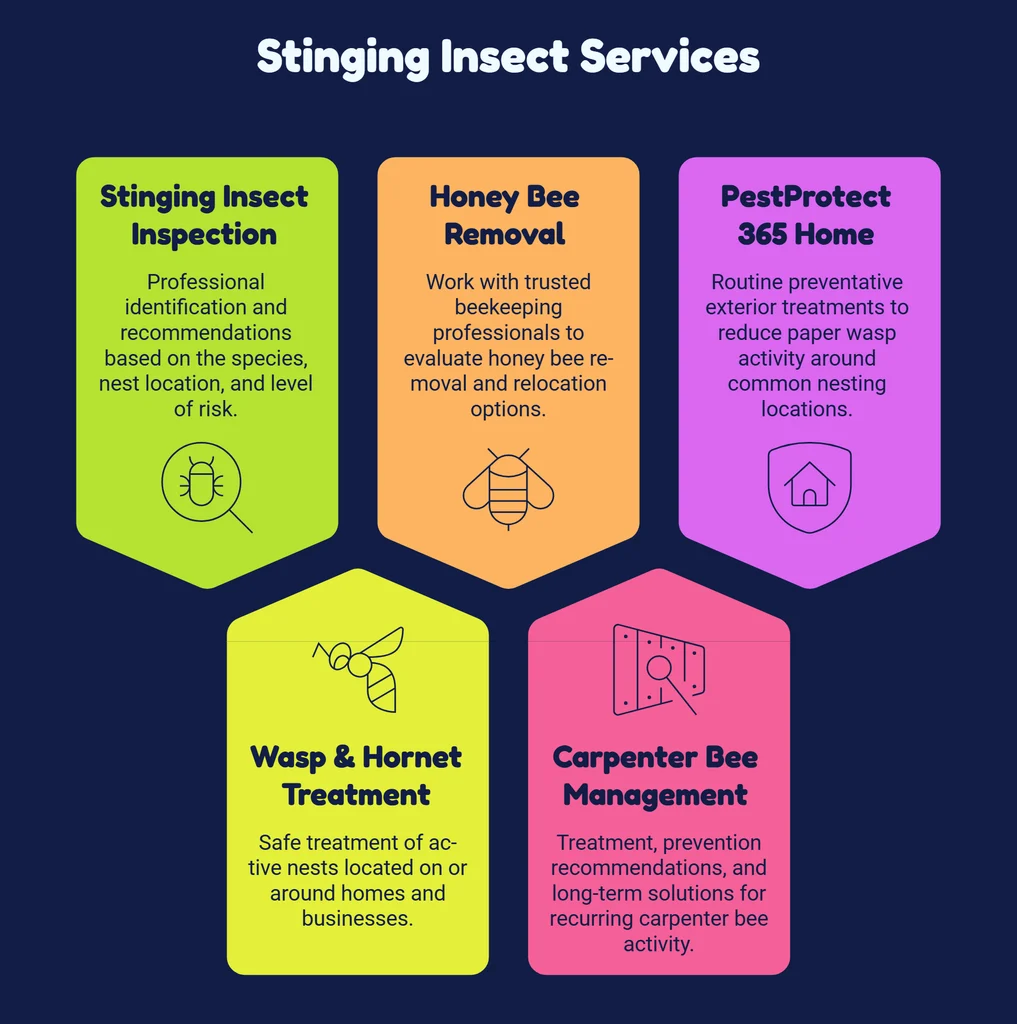
Stinging Insect Inspection →
Professional identification and recommendations based on the species, nest location, and level of risk.
Wasp & Hornet Nest Treatment →
Safe treatment of active nests located on or around homes and businesses.
Honey Bee Colony Removal →
When practical, we work with trusted beekeeping professionals to evaluate honey bee removal and relocation options rather than simply exterminating beneficial colonies.
Carpenter Bee Management →
Treatment, prevention recommendations, and long-term solutions for recurring carpenter bee activity.
PestProtect 365 Home →
Many wasps begin constructing small nests in the spring. Routine preventative exterior treatments can often reduce paper wasp activity around eaves, porches, decks, and other common nesting locations before colonies become established. (Ground-nesting species such as yellowjackets and protected pollinators may require different management approaches.)
Need fast, reliable help? Our team is ready to assist you today.
Still Have Questions?
If you’re not sure what type of stinging insect you’re seeing, don’t worry,that’s one of the most common reasons people call us.
A clear photo is often enough for our team to identify the species and help determine whether treatment is recommended, whether the insects can simply be monitored, or whether another solution may be more appropriate.
📅 Schedule an Inspection →
📞 Contact Zuckerman’s Pest Management →
📸 Text or email us a photo,we’re often able to identify common stinging insects before scheduling a visit.
Meet the Expert Behind This Guide
Jerika Zuckerman, ACE
Associate Certified Entomologist • Co-Owner
Jerika Zuckerman is an Associate Certified Entomologist (ACE) through the Entomological Society of America and co-owner of Zuckerman’s Pest Management. She specializes in insect identification, integrated pest management (IPM), and educating homeowners about the insects commonly found throughout Central Ohio.
Her philosophy is simple:
Proper identification leads to better decisions.
Whether the recommendation is treatment, relocation, monitoring, or simply leaving beneficial pollinators alone, every recommendation begins with understanding the insect first.
Sources & References
This guide is based on current entomological research, university extension publications, integrated pest management principles, and field experience serving homeowners and businesses throughout Central Ohio.
Primary references include:
- Entomological Society of America (ESA)
- Ohio State University Extension
- Ohio Department of Agriculture
- National Pest Management Association (NPMA)
- USDA Pollinator Resources
- Xerces Society for Invertebrate Conservation (for pollinator education)
- University Extension publications on stinging insects
- Peer-reviewed research on social wasps, bees, and integrated pest management
Educational Disclaimer
This guide is intended for educational purposes and discusses the stinging insects most commonly encountered throughout Central Ohio. Every species behaves differently, and recommendations vary depending on the insect involved, nest location, season, and potential safety concerns. Professional identification is recommended before attempting to treat or remove any active nest.
Need fast, reliable help? Our team is ready to assist you today.
Frequently Asked Questions
What’s the difference between a bee, a wasp, and a hornet?
Although they’re often grouped together, they’re quite different.
Generally speaking, bees are important pollinators that feed on nectar and pollen. Wasps are predators that help control other insects, while hornets are actually a type of social wasp. Each species behaves differently, builds different nests, and requires a different management approach.
Should I remove a wasp nest myself?
That depends on the species, the size of the nest, and where it’s located.
Small, easily accessible nests that are no longer active may sometimes be safely removed. However, active nests located inside structures, near entry doors, or in difficult-to-reach areas are best handled by a trained professional. Attempting to remove an active nest without proper equipment can increase the risk of multiple stings.
Are honey bees protected?
Honey bees are extremely valuable pollinators, and whenever practical, we prefer removal over extermination when colonies have established themselves inside structures.
Each situation is unique, and recommendations depend on the colony’s location, accessibility, safety concerns, and whether relocation is feasible.
Do carpenter bees damage homes?
Yes.
While a single carpenter bee usually causes only minor damage, repeated nesting over several years can create extensive tunnel systems in exposed wood. Repairing existing galleries and preventing future nesting is often more effective than simply treating the bees each spring.
Why do I suddenly have yellowjackets in late summer?
Yellowjacket colonies naturally reach their largest size during late summer and early fall. As food sources change and colonies mature, workers become more active around outdoor meals, garbage cans, sugary drinks, and other human food sources, making them much more noticeable.
What’s the large wasp hovering over my yard?
If it’s flying low over the ground in mid-to-late summer, it’s very likely a male cicada killer.
Although their size can be intimidating, male cicada killers cannot sting, and females are generally very reluctant to sting unless directly handled.
Will stinging insects return every year?
Sometimes.
While many annual colonies die out each fall, the same favorable nesting locations may attract new queens the following spring. Preventative treatments, exclusion work, and routine inspections can often reduce repeated nesting around homes and businesses.
What if I’m allergic to bee or wasp stings?
If anyone in your household has a known allergy to stinging insects, we recommend addressing nests located on or around the home sooner rather than later. If you’re ever stung and experience difficulty breathing, swelling of the face or throat, dizziness, or other signs of a severe allergic reaction, seek emergency medical care immediately.