Few household pests generate as much fear, or as many misconceptions, as spiders.
For some homeowners, spotting a single spider in the basement is enough to raise concern. Others seem unfazed unless they’re constantly walking through webs around the porch or finding spiders in multiple rooms of the house.
The truth usually falls somewhere in between.
Most spiders found in Ohio are harmless to people and play an important role in the environment by feeding on insects and other small arthropods. In many ways, they’re nature’s pest control specialists.
However, that doesn’t necessarily mean you want them living inside your home.
A spider indoors often tells us something important. It may indicate that insects are available as food, that suitable shelter exists, or simply that the spider wandered inside while searching for a mate or a protected place to spend the winter.
Understanding why spiders are present is often far more useful than focusing only on the spider itself.
At Zuckerman’s Pest Management, we believe successful spider management begins with education. Rather than treating every spider the same, we help homeowners understand which species are common in Ohio, which ones deserve closer attention, why spiders enter homes, and how reducing the insects they feed on often leads to fewer spiders over time.
This guide serves as the cornerstone of the Spiders section within the Zuckerman’s Pest & Wildlife Learning Library. We’ll explain the most common spiders found in Central Ohio, separate fact from fiction, and provide practical recommendations for reducing spider activity around your home.
Need fast, reliable help? Our team is ready to assist you today.
Quick Facts About Spiders in Ohio
| Topic | Information |
| Primary Activity Season | Year-round (highest activity spring through fall) |
| Peak Indoor Activity | Late summer through fall |
| Are Spiders Insects? | No. Spiders are arachnids, closely related to ticks, mites, and scorpions. |
| How Many Legs? | Eight |
| Primary Food Source | Insects and other small arthropods |
| Do All Ohio Spiders Build Webs? | No. Many species actively hunt rather than building capture webs. |
| Professional Spider Control Available? | Yes. Spider management is included as part of our comprehensive PestProtect 365 Home program and focuses on reducing both spiders and the insects that attract them. |
What Exactly Is a Spider?
One of the most common misconceptions we encounter is that spiders are insects.
They’re not.
Spiders belong to a completely different group of animals known as arachnids, making them close relatives of ticks, mites, and scorpions.
Unlike insects, spiders have:
- Eight legs instead of six.
- Two primary body segments instead of three.
- No wings.
- No antennae.
Perhaps the most remarkable feature of spiders is their ability to produce silk. While many people associate silk only with webs, spiders actually use silk for many different purposes, including:
- Building egg sacs.
- Creating safety lines.
- Wrapping prey.
- Constructing retreats.
- Building capture webs.
- Traveling by “ballooning,” where young spiders ride air currents using strands of silk.
Not every spider spins the classic circular web most people imagine. Many Ohio spiders actively hunt insects without relying on webs at all.
Why Do I Have Spiders in My House?
One of the biggest myths about spiders is that they invade homes for no reason. In reality, spiders usually have a very good reason for being there. Like every living creature, they’re searching for the things they need to survive.
Food
The number one reason spiders remain inside a home is simple: Food.
Spiders feed primarily on insects and other small arthropods. If your home consistently supports flies, ants, beetles, moths, gnats, or other insects, it naturally becomes more attractive to spiders. One of the most effective long-term spider management strategies is actually reducing the insect populations they depend on.
Shelter
Homes provide stable temperatures, protection from predators, and countless quiet hiding places. Common indoor hiding locations include:
- Basements
- Crawl spaces
- Garages
- Storage rooms
- Closets
- Utility rooms
- Attics
- Window frames
Seasonal Changes
Many homeowners notice more spiders during late summer and early fall. This doesn’t necessarily mean the spider population has suddenly exploded. Instead, mature spiders become more active as they search for mates and protected overwintering sites. As temperatures begin cooling outdoors, wandering spiders often become much more noticeable indoors.
Lights Attract Insects…
…which attract spiders.
Exterior lighting frequently draws flying insects to doors, windows, porches, and garages after dark. Spiders quickly learn these areas provide an excellent opportunity to catch prey. It’s one reason you may notice webs appearing repeatedly around porch lights or entryways.
Are Spiders Good or Bad?
The honest answer is: Both.
From an ecological standpoint, spiders are incredibly beneficial. They help control countless insect populations every day and are an important part of healthy ecosystems.
However, that doesn’t necessarily mean homeowners want spiders sharing their living room, basement, or bedroom.
The goal isn’t to eliminate every spider from the environment. The goal is keeping spiders where they belong, primarily outdoors, and minimizing unwanted activity inside the home.
That’s one reason professional spider management focuses on the conditions attracting spiders, rather than simply treating the spiders themselves.
Common Spiders Found in Central Ohio
Ohio is home to hundreds of spider species, but only a relatively small number are commonly encountered around homes. Most are harmless, prefer to avoid people, and spend their lives feeding on insects that many homeowners would rather not have around.
Learning to recognize the more common species can help reduce unnecessary concern while making it easier to identify situations where professional assistance may be beneficial.
Wolf Spiders (Family: Lycosidae)
Wolf spiders are among the largest and most frequently encountered spiders in Ohio, making them one of the species homeowners are most likely to notice, and one of the most commonly misidentified.
Unlike many spiders, wolf spiders do not build webs to catch prey. Instead, they actively hunt insects across the ground, relying on excellent eyesight and speed rather than silk.
Wolf spiders are commonly found in:
- Basements
- Garages
- Crawl spaces
- Wood piles
- Landscape beds
- Around foundations
- Under rocks and logs
Because of their size and quick movements, wolf spiders often startle homeowners. Fortunately, they are generally not aggressive and almost always attempt to escape rather than bite when disturbed.
One of the most fascinating characteristics of wolf spiders is their maternal behavior. Female wolf spiders carry their egg sacs attached to the end of their abdomen. After the eggs hatch, the tiny spiderlings climb onto their mother’s back, where she carries them until they’re old enough to disperse on their own. It’s one of the few examples of prolonged parental care found among spiders.
Jumping Spiders (Family: Salticidae)
Jumping spiders are often considered the “puppies” of the spider world because of their curious behavior and remarkable eyesight.
These compact, fuzzy spiders actively hunt during the day and are well known for:
- Large forward-facing eyes.
- Excellent vision.
- Short, powerful jumps.
- Curious movements.
Unlike web-building spiders, jumping spiders stalk their prey much like a cat stalking a mouse before making an impressive leap.
Many homeowners are surprised to learn that jumping spiders can recognize movement from several feet away and will often stop to observe people rather than immediately fleeing. Although they appear intimidating because they jump, they are harmless to people and are considered beneficial predators.
Cellar Spiders (Family: Pholcidae)
Often called “daddy longlegs spiders,” cellar spiders are recognized by their extremely long, delicate legs and small bodies.
They’re frequently found in:
- Basements
- Crawl spaces
- Garages
- Utility rooms
- Corners of ceilings
- Storage areas
A common myth claims cellar spiders are “the most venomous spider in the world but their fangs are too short to bite people.” This is completely false.
Like nearly all spiders, cellar spiders possess venom for subduing their insect prey. However, they are not considered medically significant to people, and the popular myth has no scientific basis. Cellar spiders actually provide a useful service by feeding on flies, gnats, mosquitoes, and even other spiders.
Orb Weavers (Family: Araneidae)
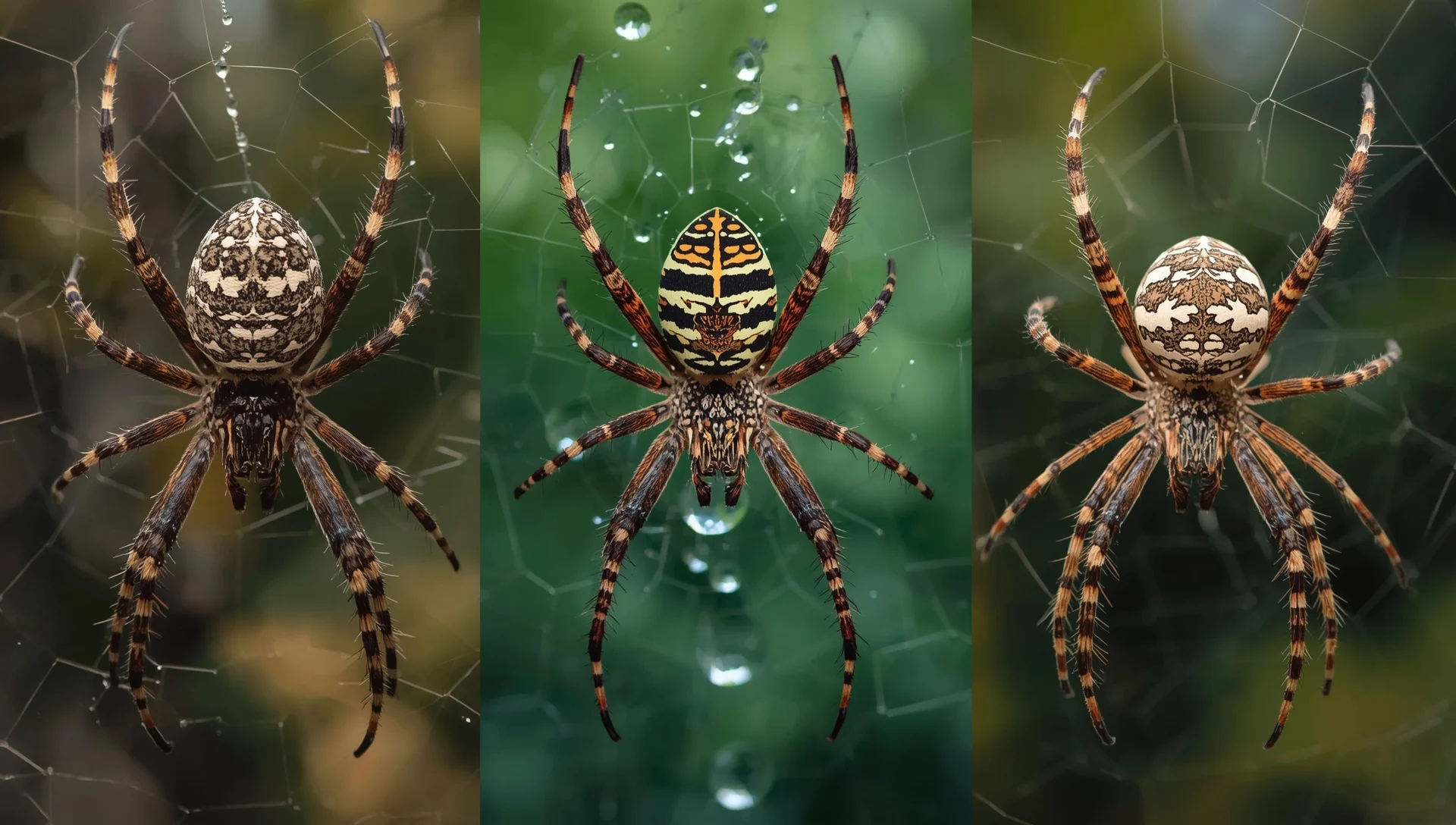
Orb weavers are responsible for the beautiful circular webs often seen stretched between shrubs, trees, fences, decks, and porch railings during late summer and fall.
These spiders are master engineers. Many rebuild their intricate webs every evening before removing and recycling portions of the silk the following morning.
Orb weavers rarely enter homes intentionally and are almost always encountered outdoors. Although their large size may appear intimidating, they are harmless to people and provide excellent natural control of flying insects.
Yellow Sac Spiders (Cheiracanthium spp.)
Yellow sac spiders are small, pale yellow to light tan spiders commonly encountered inside homes.
Unlike orb weavers, they don’t construct large capture webs. Instead, they build small silk retreats, called sacs, where they rest during the day before actively hunting insects at night.
Homeowners often discover them:
- On walls
- Near ceilings
- Around windows
- Behind furniture
- Inside closets
Because they actively wander while hunting, yellow sac spiders are among the species people most frequently encounter indoors.
Fishing Spiders (Family: Pisauridae)
Fishing spiders are among Ohio’s largest spiders and often surprise homeowners because of their impressive size.
They’re commonly associated with:
- Lakes
- Streams
- Ponds
- Wetlands
- Docks
- Boathouses
Unlike wolf spiders, fishing spiders are capable of walking across the surface of water and even diving beneath it while hunting aquatic insects and small animals. Despite their intimidating appearance, they are shy spiders that prefer avoiding people.
Medically Significant Species: Myth vs. Reality
Brown Recluse Spiders
Few spiders generate more concern than the brown recluse. The reality, however, is often very different from popular belief.
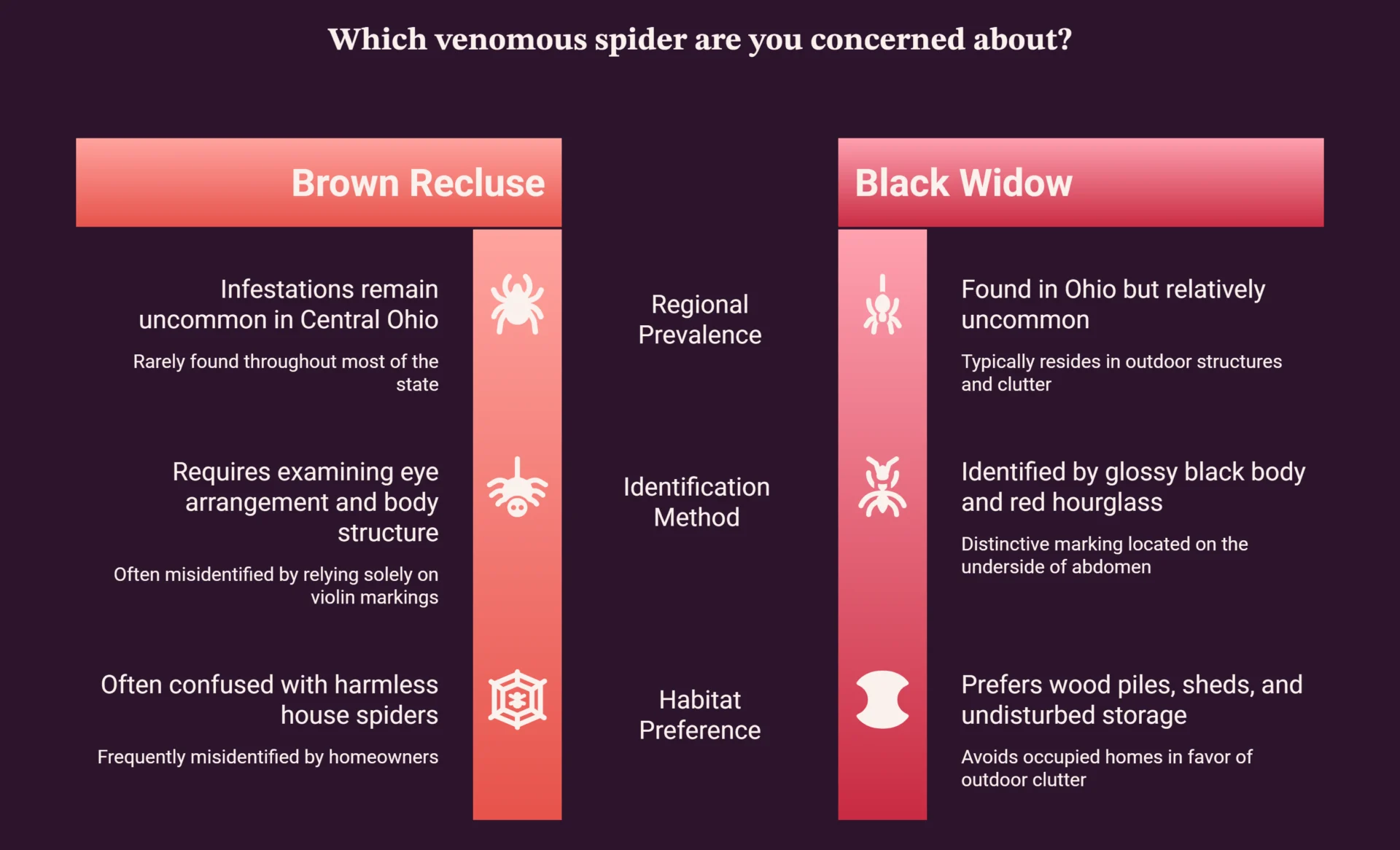
Brown recluse spiders are NOT common throughout most of Ohio.
While isolated populations have occasionally been documented, particularly in the southwestern portion of the state, verified brown recluse infestations remain uncommon in Central Ohio. In fact, many spiders submitted for identification as “brown recluses” turn out to be harmless species such as wolf spiders, nursery web spiders, or yellow sac spiders.
One of the defining characteristics of a true brown recluse is the distinctive violin-shaped marking located on the front portion of the body. However, relying on that marking alone can lead to misidentification. Accurate identification often requires examining several characteristics, including eye arrangement and body structure. For this reason, homeowners should avoid assuming every brown spider is a recluse.
Black Widow Spiders
Black widow spiders are found in Ohio but are relatively uncommon, particularly inside occupied homes.
They typically prefer:
- Wood piles
- Sheds
- Crawl spaces
- Utility boxes
- Undisturbed storage areas
- Outdoor clutter
Adult females are glossy black with the familiar red or orange hourglass marking on the underside of the abdomen. Although black widow bites can require medical attention, these spiders are not aggressive and generally bite only when trapped or accidentally pressed against the skin. Routine cleaning and reducing clutter around structures greatly reduces the likelihood of encounters.
Need fast, reliable help? Our team is ready to assist you today.
Should I Be Worried About Spiders?
For the vast majority of Ohio homeowners, the answer is: Probably not.
Most spiders found around homes are harmless, beneficial predators that help reduce insect populations. However, recurring spider activity indoors often suggests that your home is providing one or more of the things spiders need:
- Food
- Shelter
- Entry points
- Quiet places to hide
Addressing those underlying conditions typically provides longer-lasting results than simply removing individual spiders as they appear.
🕷️ ACE Insight
With Jerika Zuckerman, Associate Certified Entomologist (ACE)
One of the questions I’m asked most often is, “What kind of spider is this?” In reality, an equally important question is, “Why is this spider here?” Spiders rarely invade homes without a reason. They’re usually following their food source or searching for shelter. That’s why long-term spider management focuses on reducing the insects that attract them, sealing common entry points, and making the home less inviting overall, not simply treating the spiders you happen to see.
Reducing Spider Activity Around Your Home
While it’s impossible, or even undesirable, to eliminate every spider from the environment, there are several practical steps homeowners can take to reduce the number of spiders found around and inside the home. The most successful spider management programs focus on making your property less attractive to both spiders and the insects they feed on.
Reduce Outdoor Lighting That Attracts Insects
Many insects are attracted to exterior lighting after dark. Where insects gather, spiders often follow. If spiders repeatedly build webs around:
- Front doors
- Garage doors
- Porch lights
- Deck lighting
- Entryways
the lighting itself may be contributing to the problem.
Consider:
- Turning unnecessary lights off when not in use.
- Using warmer-colored LED bulbs rather than bright white lights where appropriate.
- Positioning decorative lighting farther from frequently used entrances.
These simple changes may reduce the number of flying insects, and therefore the spiders that feed on them.
Seal Common Entry Points
Like many household pests, spiders often enter through surprisingly small openings. Inspect areas such as:
- Door sweeps
- Window screens
- Utility penetrations
- Foundation cracks
- Garage doors
- Gaps around siding
Although complete exclusion isn’t always possible, reducing available entry points helps limit indoor activity.
Keep Storage Areas Organized
Spiders prefer quiet areas that are rarely disturbed. Garages, basements, crawl spaces, attics, and storage rooms often provide ideal shelter.
Whenever practical:
- Reduce unnecessary clutter.
- Store items in sealed plastic containers instead of cardboard boxes.
- Vacuum corners and webs regularly.
- Avoid stacking firewood directly against the home.
These simple maintenance practices reduce available hiding places.
Control the Insects Spiders Feed On
This is perhaps the most important point in the entire article. Spiders stay where food is plentiful. If flies, ants, beetles, moths, gnats, stink bugs, or other insects are consistently entering your home, spiders are much more likely to remain as well.
By reducing the insects that attract spiders, homeowners often notice a significant decrease in spider activity over time.
Should You Remove Spider Webs?
Yes.
While removing webs doesn’t eliminate spiders, it does discourage many species from repeatedly using the same locations. Routine removal of webs from:
- Eaves
- Porch ceilings
- Window frames
- Deck railings
- Garage corners
- Exterior lighting
helps keep spiders from establishing long-term web sites around the home.
For orb weavers, however, it’s worth remembering that many build entirely new webs each evening. If you remove a web in the morning and notice another one the following day, it’s often because the spider simply rebuilt it overnight, not because the previous removal “didn’t work.”
How Zuckerman’s Approaches Spider Management
At Zuckerman’s Pest Management, we don’t believe effective spider control starts with spraying every spider we see. Instead, we begin by asking a different question: Why are spiders thriving here?
Because spiders depend on insects for food, successful spider management usually involves addressing the conditions that support both spiders and their prey.
During an inspection, we evaluate factors such as:
- Exterior lighting that attracts insects.
- Heavy web accumulation.
- Entry points around the structure.
- Moisture issues.
- Insect activity inside the home.
- Landscaping that provides excessive shelter.
- Areas where spiders commonly rest or build webs.
Spider management is included as part of our PestProtect 365 Home program, which focuses on preventing a wide variety of household pests, not just spiders. By reducing the insects that attract spiders and maintaining a consistent preventative program, homeowners often experience a noticeable reduction in spider activity throughout the year.
As with all of our services, treatment recommendations and warranty coverage vary depending on the specific pest concerns and program selected. Additional information can be found within your service agreement and throughout the individual service pages on our website.
Conclusion
Spiders are among the most misunderstood animals found around Ohio homes. While many people view them with concern, the vast majority of species commonly encountered in Central Ohio are harmless predators that spend their lives helping control insect populations.
That said, it’s perfectly reasonable to want spiders to remain outdoors rather than inside your living space.
Understanding why spiders enter homes, reducing the insects that attract them, sealing common entry points, and maintaining your property are all important parts of long-term spider management.
At Zuckerman’s Pest Management, we believe effective spider control isn’t simply about treating visible spiders; it’s about addressing the conditions that allow them to thrive in the first place. Through science-based recommendations and comprehensive preventative pest management, we help homeowners enjoy fewer spiders, fewer insects, and greater peace of mind throughout the year.
Sources & References
This article was developed using information from authoritative scientific and educational resources, including:
- Entomological Society of America (ESA)
- Ohio State University Extension
- Penn State Extension
- Purdue University Extension
- University of Kentucky Entomology
- University of California Statewide Integrated Pest Management Program (UC IPM)
- Centers for Disease Control and Prevention (CDC)
- National Pest Management Association (NPMA)
About the Author
Jerika Zuckerman, ACE is the Co-Owner of Zuckerman’s Pest Management, a family-owned pest and wildlife management company serving homeowners and businesses throughout Central Ohio.
As an Associate Certified Entomologist (ACE) credentialed by the Entomological Society of America (ESA), Jerika combines years of practical field and office experience with a passion for insect biology, Integrated Pest Management (IPM), and consumer education. Through the Zuckerman’s Pest & Wildlife Learning Library, she is committed to helping homeowners understand not just how to solve pest problems, but why those problems occur in the first place.
Need fast, reliable help? Our team is ready to assist you today.
Frequently Asked Questions
Are spiders beneficial?
Yes. Most spiders provide valuable natural pest control by feeding on insects and other small arthropods. From an ecological perspective, they play an important role in maintaining balanced ecosystems.
Why am I suddenly seeing more spiders in my house?
Spider activity often becomes more noticeable during late summer and fall as mature spiders search for mates and protected places to spend the winter. Increased indoor insect activity may also attract more spiders.
Do all spiders build webs?
No. Many common Ohio spiders, including wolf spiders and jumping spiders, actively hunt prey instead of relying on capture webs.
Should I leave spiders alone?
Outdoor spiders are generally beneficial and rarely cause problems. Indoors, however, recurring spider activity may indicate conditions that are also attracting other household pests.
Are brown recluse spiders common in Central Ohio?
No. Although isolated populations have occasionally been documented in Ohio, verified brown recluse infestations remain uncommon throughout most of Central Ohio. Many spiders mistakenly identified as brown recluses turn out to be harmless native species.
Are black widow spiders found in Ohio?
Yes. Black widow spiders do occur in Ohio but are relatively uncommon and are most often associated with undisturbed outdoor storage areas rather than occupied living spaces.
What’s the best way to keep spiders out of my house?
Reducing insect populations, sealing entry points, removing webs, minimizing clutter, and maintaining a preventative pest management program all contribute to long-term spider reduction.