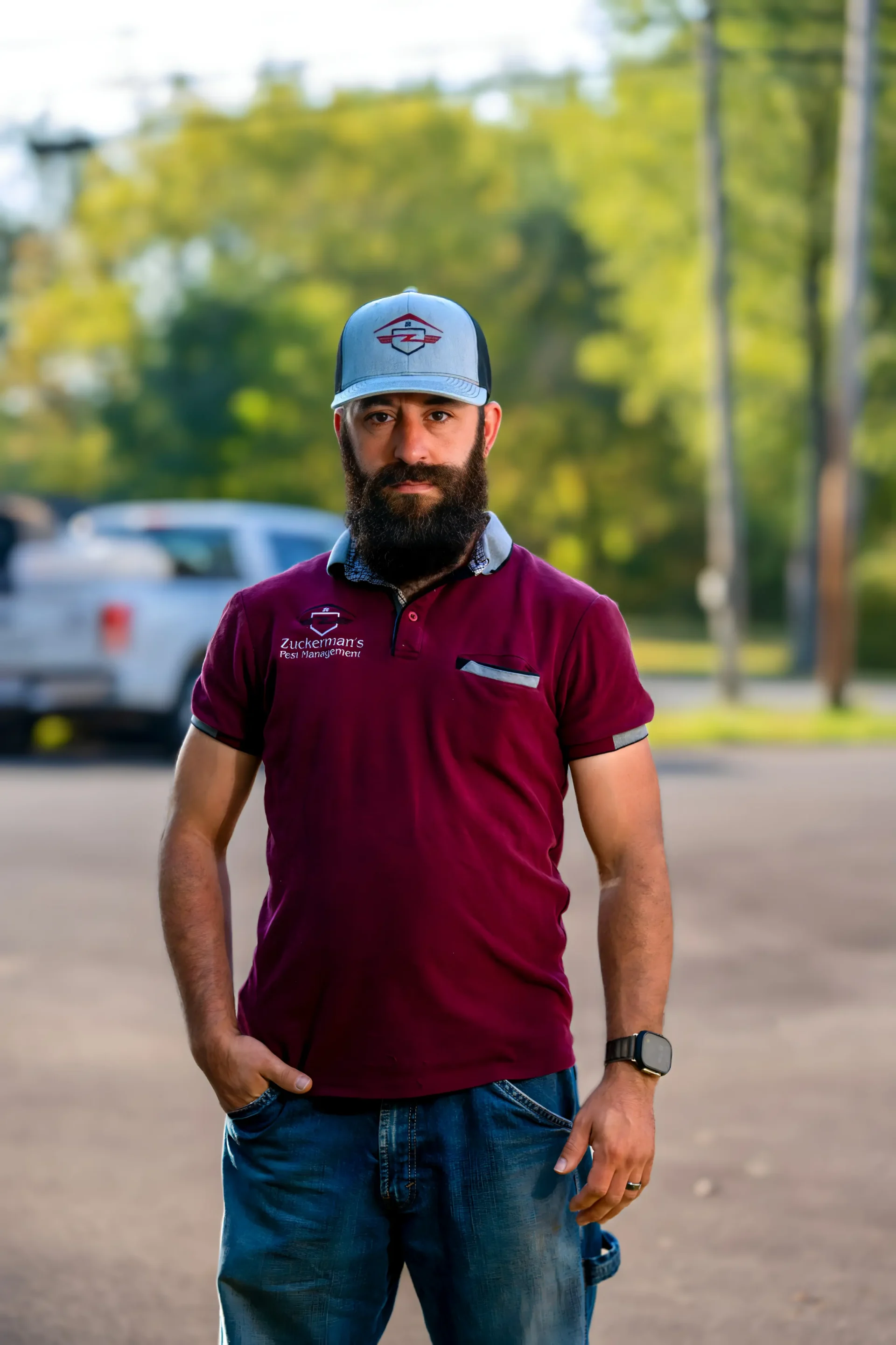
I’m Better at Finding Entry Points Than Writing Biographies
If this page seems a little shorter than everyone else’s, there’s probably a reason.
I’d rather be in an attic figuring out how a squirrel got into a house than sitting at a desk figuring out how to explain why I’m good at figuring out how a squirrel got into a house.
So, here’s the important stuff.
I like problems.
More specifically, I like figuring out why something is happening—and finding the solution that actually makes sense.
Sometimes that means a treatment. Sometimes it means exclusion or a structural repair. And sometimes the best answer doesn’t involve a pesticide at all.
If a material, repair, or change to the structure can prevent the problem instead, that’s usually the direction that interests me most.
My goal isn’t to pressure you into anything.
It’s to inspect thoroughly, figure out what’s actually going on, lay out a plan, and make sure you understand your options.
If I leave your home and you feel informed, comfortable with the plan, and a little less stressed than you were when I showed up, I did my job.
And if the solution happens to involve crawling through an attic instead of writing another paragraph about myself?
Even better.
Don’t Feel Like Reading My Entire Life Story?
Fair.
I didn’t particularly want to write it either.
If you’re here for something specific, use one of the buttons below and skip ahead. No hard feelings.
- How I Ended Up in Pest Control
- What You Can Expect From Me
- Rodents, Wildlife & Problem Solving
- The Spray Foam Kings
- Why We Built Zuckerman’s This Way
- Apparently I Analyze People Too
- What I’m Like Off the Clock
- The People Behind All of This
- Experience, Licenses & Credentials
Go ahead. Skip around. I promise there isn’t a quiz at the end.
Apparently, Fleas Were a Career Opportunity
I didn’t grow up planning to work in pest control.
My now-wife and I moved into an apartment that had been sitting empty for about four months. She was eight months pregnant at the time, the previous tenants had dogs, and they left us a flea problem as a housewarming gift.
My wife was working in property management, so we had a pest control company she knew come out.
The technician started telling me some of the crazier stories from the job and basically dared me to keep listening.
About an hour and a half later, he asked if I was looking for work.
Apparently I asked enough questions that he thought I might be good at it.
He offered to give his boss my name, and what started as a flea treatment turned into a career I’ve now been in since 2012.
It turns out pest control fits the way my brain works pretty well.
Very few things are exactly what they seem at first.
You have to look at the structure, the environment, the behavior of the pest or animal, what changed, where it’s getting access, and sometimes what everyone before you may have missed.
That part hooked me.
Years later, when it came time for Zuckerman’s, I didn’t exactly join the company.
I helped found it.
My wife and I took the dive on September 29, 2017, and built Zuckerman’s around the kind of work we believed should be done:
Investigate thoroughly. Keep learning. Tell people the truth. Recommend what actually solves the problem.
Sometimes that’s pest control.
Sometimes it’s wildlife work.
Sometimes it’s repairing a hole.
And sometimes the most important thing I can tell you is that you don’t need what you thought you needed.
I’m perfectly fine with that.
What You Can Expect From Me
I’m Going to Look Beyond the Obvious
A mouse in the kitchen, scratching in the attic, insects around a window, or a smell you can’t identify tells me where you noticed the problem.
It doesn’t necessarily tell me where the problem started.
I want to know why it’s happening.
Sometimes a small detail changes the entire recommendation, and I’d rather spend extra time investigating than give you a quick answer that happens to be wrong.
Questions Don’t Bother Me
If you want to follow me around while I inspect, go for it.
Ask what I’m looking at. Ask why. Ask what happens next.
I’d much rather teach you what I’m seeing than expect you to take my word for it.
I’ll Separate What You Need From What You May Want to Prevent Later
Those aren’t always the same thing.
There may be work that needs to happen now to resolve the existing problem. There may also be improvements worth considering to reduce the chance of another problem in the future.
I think you deserve to know the difference.
If you don’t need something, I’m not interested in convincing you that you do.
And No, I’m Not There to Judge Your House
Pests and wildlife don’t check your neighborhood, bank account, square footage, or housekeeping before deciding to move in.
Anybody can end up with them.
So if you’re embarrassed when I arrive, don’t be.
I’m much more interested in figuring out why it’s happening and what we’re going to do about it.
What I hope you remember after I leave: He respected my home, taught me what was going on, and never pressured me into a decision.
If It’s Weird, Complicated, or Someone Else Couldn’t Figure It Out… I’m Interested.
The part of this work I enjoy most is problem-solving.
Give me something that doesn’t quite add up, an issue that keeps coming back, or a problem where the obvious answer hasn’t worked, and I’m probably going to want to dig into it.
Rodent and wildlife work naturally gives me a lot of that.
Finding an animal is one thing.
Figuring out how it got there, why it chose that area, what part of the structure allowed it, and how to keep the next one from doing the same thing is the part I really enjoy.
The same thinking applies to insects.
Why are they there?
What are they following?
What changed?
Is there moisture? An entry point? A food source?
Are we even dealing with the pest everyone assumes we’re dealing with?
Sometimes the answer is pesticide.
Sometimes it isn’t.
I Have a Soft Spot for Solutions That Don’t Come Out of a Sprayer
We use pesticides when they’re appropriate, and knowing how and when to use them correctly is part of the job.
But one of my favorite outcomes is finding a way to solve or prevent a problem with a material, repair, exclusion method, or structural correction instead.
If I can physically stop an animal from getting into your house instead of repeatedly dealing with it after it gets inside, that makes sense to me.
And if we can correct the condition contributing to an insect problem rather than endlessly treating the symptom, even better.
Expert Side Note: A Word About the Spray Foam Kings
I know spray foam is convenient.
I know it comes in a can.
I know the internet gods said to fill the hole with it.
And if you’ve previously hired a Spray Foam King who foamed every opening he could find—or spent a Saturday following the advice of the internet gods and did it yourself—I’m not judging you.
But if the foam solved the problem…
you probably wouldn’t be reading my page because you still had to call us.
Spray foam doesn’t fix nearly as many pest and wildlife problems as people think it does. In the wrong application, it can create an entirely different set of problems.
And no, adding more foam usually isn’t the answer either.
There are materials designed for specific jobs. Openings that need to be properly excluded. Repairs that need to be actual repairs.
Before we seal something, I want to know:
What made the opening? What’s using it? Where does it lead? And what happens if we close it?
Filling a hole is easy.
Understanding whether filling that hole actually solves the problem is the part that matters.
We Built the Company We Wanted to Work For
Obviously, I didn’t choose Zuckerman’s from a list of pest control companies.
My wife and I built it.
But we had both spent enough time around the industry—and around customers—to know there were things we wanted to do differently.
For me, a big part of that comes down to something simple:
Solve the problem. Tell people the truth. Keep learning.
If you need something, I’ll tell you.
If you don’t need it, I’ll tell you that too.
And if there’s something you could do to help prevent another problem in the future, I’ll explain that as a preventative option—not pretend it’s required to solve the problem you called us about today.
There’s a difference.
Integrity Gets Really Simple When Nobody Is Watching
One of the things I wrote when I was forced to fill out the questionnaire for this page was:
Doing what’s right even when nobody’s looking.
That’s what professionalism means to me.
It applies when I’m talking to a customer, but it also applies when I’m in an attic where the homeowner can’t see what I’m doing.
It applies when a repair takes longer than expected.
It applies when the recommendation that makes the most sense for the customer isn’t the one that makes us the most money.
And it applies when we make a mistake.
We’re human. Mistakes happen.
What matters is what you do next.
That’s the kind of company my wife and I wanted to build.
Not the biggest company.
Not the company with the fanciest sales pitch.
A company that’s really good at solving problems—and that people can trust to tell them the truth about what it’s going to take.
Sometimes the Problem Isn’t the Problem
One thing this career has taught me is that you can’t always take the first thing you see—or hear—at face value.
That includes customers.
I once went to a home where the customer was clearly irritated with us before I really had a chance to get started.
Those appointments are always fun.
My first instinct could have been to get defensive, explain why we were right, do the service, and leave.
Instead, I started asking questions.
Not pest-control questions at first.
I wanted to understand why she was upset.
Once we talked through it, I realized the issue wasn’t really what I thought it was when I walked in. She had concerns and expectations that hadn’t been fully understood.
Once I knew what she actually needed from us, the whole appointment changed.
We developed a better plan for her, and she ultimately asked us to do additional work at the home.
The lesson stuck:
Listen before you decide what problem you’re there to solve.
That’s true when I’m inspecting a house, too.
The mouse you saw isn’t necessarily the problem.
The hole isn’t necessarily the problem.
The insect you’re finding may not be coming from where you think it is.
And the frustrated customer standing in front of me may not actually be upset about the thing I assumed they were upset about.
Slow down.
Ask questions.
Figure out what you’re actually dealing with.
Then solve that problem.
Apparently, I Investigate People Too
I’ve always been fascinated by how people think and why they behave the way they do.
I read about psychology, criminal behavior, and how the human mind works—which probably explains the somewhat questionable collection of books on one of our shelves at home.
It also comes in handy at work.
People don’t always say exactly what they’re worried about. Sometimes they’re embarrassed. Sometimes they’re frustrated about something that happened before I arrived. Sometimes they’re convinced they already know what’s causing the problem.
I’m pretty good at reading the room.
According to my wife, with approximately 98.56475% accuracy.
The other 1.43525% is presumably why I’m married.
Apparently I’m Supposed to Have an “Off” Switch
I spend a lot of my time with my wife.
I’m going to mention that several times because she’s eventually going to read this page, and I’m not above collecting brownie points where I can get them.
We have four kids, all very different from one another, and being their dad is one of the most important parts of my life.
There are never enough hours in the week to give each of them as much individual time as I’d like, so I try to make the time we do have count.
That means meeting each of them where they are—even when that occasionally involves sitting across from a new boyfriend or girlfriend and conducting what I’ve been informed is supposed to be a conversation, not an interview.
I’m working on it.
Recently, I also became Papa.
Apparently becoming a grandfather means I’m supposed to be the wise one now.
We’ll see how that goes.
Being a grandfather is one of the best things that’s happened to me, and I’m incredibly proud of the people my kids are becoming.
Most of My Free Time Is Actually Spent Chasing My Wife’s Ideas
If you know my wife, you know there is always an idea.
Usually several.
Possibly 92½ before lunch.
My role in many of these situations is apparently to figure out how we’re going to make them happen.
Dream kitchen?
We built it.
Chickens?
Sure.
Except chickens apparently required a chicken coop, which became less of a coop and more of a chicken mansion that stands tall enough to have its own property assessment.
Gardens. Projects. Repairs. Camping. Canning things in the kitchen. Building things. Fixing things.
At some point my wife decided we needed a camper—which is essentially a house on wheels, because apparently owning one house full of projects wasn’t enough.
So we camp, too.
And the truth is, I enjoy it.
I like working with my hands. I like building things. And if something makes my wife or my kids happy, there’s a pretty good chance I’m going to figure out how to make it happen.
Brownie point #2.
Vacation Does Not Stop the Inspections
We’ve toured nine European countries in about three weeks, missed a flight home from Israel and somehow turned it into a 24-hour pit stop in Greece, and once managed to visit Italy for approximately four and a half hours during a layover.
You’d think somewhere in there I’d stop thinking about pest and wildlife work.
I do not.
We can be thousands of miles from home, surrounded by incredible architecture and centuries of history, and I’m still the guy pointing at a building saying:
“They need a bird vent guard.”
“Look at that ridge.”
“See that chimney? No chimney cap.”
“LOOK AT THE SIZE OF THAT ANT.”
European hornets?
I need a picture.
Bird I’ve never seen before?
Picture.
Different insect?
Picture.
Interesting plant?
Picture.
Some unusual structural detail that absolutely nobody else on vacation cares about?
Definitely a picture.
My family’s vacation photos are an interesting combination of beautiful places, family memories, unidentified insects, birds, plants, and close-ups of other people’s structural deficiencies.
Maybe I don’t actually turn pest control off.
I just change locations.
A Few Things About Me
Current Job Title at Home: Making my wife’s next idea happen.
Number of Kids: Four. Somehow all four came with completely different operating instructions.
Newest Title: Papa.
Thoughts on Becoming a Grandfather: I’m told grandfather status comes with wisdom. Apparently mine is still processing.
Vacation Habit I Cannot Turn Off: Inspecting buildings that nobody hired me to inspect.
My Camera Roll: Family. Beautiful scenery. Bug. Bird. Structural deficiency. Family. Plant. Giant hornet. More structural deficiencies.
When My Wife Says, “I Have an Idea…”: I start figuring out what we’re going to need from the hardware store.
Smallest Project That Got Slightly Out of Hand: The chicken coop. It is not a coop. It is a chicken mansion.
My Relationship With Spray Foam: It’s complicated. Actually, no. I hate it.
The People Who Help Build All of This
There are a lot of things on this page about what I do, but none of what we’ve built happened because of one person.
My wife and I have a small circle of very close friends—some personal, some people we met through this industry—who have become an important part of our lives.
They’re the people we call to talk through an idea, ask a question, get another opinion, learn from, laugh with, or occasionally tell us when we’re completely off our rockers.
Somewhere along the way, some of the people we met because of pest control stopped being industry friends and just became friends.
They’ve helped shape who we are—in business and outside of it.
And Then There’s Our Team
When my wife and I started Zuckerman’s, our dreams for it were honestly pretty modest.
Do good work. Take care of customers. Make a living. Build something we could be proud of.
Then other people started believing in what we were building.
And those small dreams started getting a whole lot bigger.
Every person who joins our team brings something we didn’t have before.
Different strengths. Different personalities. Different ideas. Different ways of connecting with customers and solving problems.
They represent our name when we’re not there.
They teach us things, challenge us to get better, and make it possible for this company to become something much bigger than the two people who started it.
My wife and I may have founded Zuckerman’s.
But we don’t build it alone.
There are customers who trusted us before anybody knew our name, friends who helped shape us, people in this industry who freely shared what they know, family members who lived through the long days and crazy ideas, and a team that shows up every day and turns those ideas into something real.
I’m proud of what we’ve built.
But I’m probably even more proud of who we’re building it with.
At the End of the Day, I Like Solving Problems
Pest control is a strange career.
People usually aren’t calling me because they’re having a particularly good day.
Something is scratching in the ceiling. Something flew out of the attic. There are bugs somewhere bugs definitely shouldn’t be. You’ve already tried three things the internet promised would work.
Or you’ve been dealing with a problem long enough that you’re frustrated and just want somebody to figure it out.
That’s where I come in.
If I’m the one who shows up at your house, show me what you’ve been seeing.
Tell me what you’ve tried.
Tell me what you’re worried about—even if you think it sounds ridiculous.
Then ask questions.
I’ll probably ask even more.
I can’t promise the answer will always be simple.
Sometimes the problem is different from what we expected. Sometimes fixing it takes time. And sometimes I’m going to point at something on your house you never noticed before and ruin your ability to never notice it again.
You’re welcome.
But I can promise that I’ll do my best to figure out what’s actually happening, explain what I find, and give you an honest recommendation for what I believe it will take to solve it.
There is a problem.
Somewhere, there is a reason for it.
And usually, if you’re willing to look closely enough, there’s a solution.
Let me go find it.
Experience & Credentials
This is the part where they made me list things.
Industry Experience
October 2012 – September 2017
I started in pest control with a company in New York that eventually transferred us to Ohio.
I’m going to leave the company’s name out of this.
The important parts are that I learned to love the industry—and learned quite a bit about what I didn’t want to do if I ever had a company of my own.
Both lessons turned out to be useful.
August 2014
I retired my New York State pesticide license after our move to Ohio.
September 29, 2017
My wife and I founded Zuckerman’s Pest Management somewhat on a whim.
There was definitely a comprehensive, carefully researched, perfectly timed business plan involved.
That’s my story, and I’m sticking to it.
The rest is history.
Ohio Licenses
If you’ve ever looked at an Ohio pesticide license, you’ll find a bunch of numbers and letters that mean absolutely nothing unless you work in the industry.
So here’s the alphabet soup, deciphered:
CORE
General pesticide safety, handling, use, and environmental protection.
Category 7 — Vertebrate Animal Control
Category 10A — General Pest Control
Category 10B — Termite Control
Category 10D — Vector Control
Category 12 — Wood-Destroying Insect Diagnostic Inspection
Commercial Nuisance Wild Animal Control Operator License
Issued by the Ohio Department of Natural Resources (ODNR) for commercial nuisance wildlife control activities in Ohio.
Wildlife Training & Certifications
Through the National Wildlife Control Operators Association (NWCOA) and other specialized wildlife training programs:
- Certified Wildlife Control Professional
- Advanced Wildlife Control Operator
- Bat Standards Certified
- Structural Bat Management Professional
- Rodent Standards Certified
- Zoonotic Disease Professional
- EPIC Certified
And yes, at some point somebody decided there needed to be multiple certifications confirming that I spend an unusual amount of time thinking about bats and rodents.
They weren’t wrong.
Structural Exclusion & Specialty Training
AAC Distributing / Ridge-Guard
Certified Ridge-Guard Installer
Xcluder
Certified Installer, with specialized training involving:
- Overhead dock and garage doors
- Entry doors, gaps, and cracks
- Dock levelers
- Automatic sliding doors
- Structural exclusion applications
GutterLock
GutterLock Certified Installer
In2Care Mosquito System
Specialized system training
Continuing Education & Industry Training
Licenses and certifications are only part of my education.
I attend professional training throughout the year because this industry never stops changing—and because I genuinely enjoy learning more about it.
Some of the recurring conferences, workshops, and professional training programs I attend include:
Purdue University Pest Management Conference
Three-day professional pest-management conference.
University of Kentucky Pest Control Short Course
Three-day pest-management education program.
PJB Pest Management Workshops
Twice-annually professional workshops with a strong focus on integrity, leadership, and building a high-caliber service model within the pest-management industry.
Ohio Pest Management Winter Training
Plus additional wildlife programs, technical workshops, manufacturer training, hands-on demonstrations, regulatory education, and industry events throughout the year.
Not all of them result in another certificate to hang on the wall.
That’s not really the point.
The goal is to come home knowing something I didn’t know when I left—and hopefully bring back something that makes our entire team better at what we do.
Yes, I occasionally travel several hours and voluntarily sit in a conference room for three days to learn more about bugs.
I have accepted what I’ve become.